Trade-In vs. Private Sale

Selling Smart and Understanding Car Depreciation

SMART SELLING EDITION — AUGUST 2026

The Real Math Behind Your Selling Choice

Convenience Has a Price — So Does Uncertainty

Selling your current vehicle sounds simple until real money enters the conversation. A dealer trade-in feels clean: hand over the keys, sign a few forms, drive away in the next car. A private sale, by contrast, can bring a larger check, but it asks for photos, messages from strangers, test-drive logistics, lien paperwork, fraud screening, and a little nerve.

Across the USA, the used-car market has been settling after the pandemic-era price spike that made three-year-old vehicles behave like scarce collectibles. Wholesale values cooled, retail inventory improved, and buyers became choosier as interest rates changed monthly payment math. That normalization matters. A trade-in offer that looked insulting in 2021 may now be surprisingly rational, especially when tax credits and reduced hassle enter the ledger.

The smarter question in the trade-in vs. private sale debate is not simply which channel pays more. It is which channel lets you capture the most net value after depreciation, taxes, reconditioning, timing, and risk. And yes, risk has a dollar value, even if nobody writes it on the bill of sale.

"Convenience has a price, but so does uncertainty."

A trade-in is not charity from the dealership, and it is not usually top dollar either. Dealers buy your vehicle at a number that leaves room for inspection, detailing, transport, auction exposure if they do not retail it, warranty administration, flooring costs, and profit.

Private sale usually wins on gross proceeds because you are selling closer to retail value. If a dealer offers $18,500 for a clean 2020 Honda CR-V and similar private listings sit around $21,000 to $22,000, that spread is real. But the private seller must earn it. You will need to prepare the vehicle, document maintenance, price it against actual local listings rather than fantasy asking prices, manage appointments, and protect yourself during payment and title transfer. Compare local listings for a Used Honda CR-V when estimating private-sale value.

The tax angle can narrow the gap quickly. In states such as Texas and Florida, trade-in value generally reduces the taxable purchase price of the replacement vehicle. Trade in a car for $20,000 on a $35,000 purchase, and you may be taxed on the $15,000 difference, not the full amount. California is different; it generally taxes the full vehicle purchase price regardless of trade-in allowance. That one state-level detail can move hundreds or even thousands of dollars. Check your state DMV or revenue department before assuming anything. For a deeper walkthrough, see how to sell your car smarter and understand what depreciation has already cost you.

Safety and speed also matter. A trade-in eliminates most post-sale exposure: no bounced cashier checks, no buyer financing delays, no stranger asking to test-drive a 400-horsepower pickup alone at dusk. Private sale can still be done safely, especially by meeting at a bank or police station, verifying funds before signing the title, and using a state-approved bill of sale. But there is friction. Sometimes a lot of it.

When Each Route Makes Sense

  • Choose a trade-in when your vehicle has a loan payoff, needs repairs, has accident history, or you value a same-day transaction.
  • Choose private sale when the vehicle is clean, well-documented, in-demand locally, and you can wait one to three weeks for the right buyer.
  • Get multiple bids. Dealer appraisal, online instant-cash offer, and private-sale comps should all be part of the same file.
  • Do not compare a trade-in offer to the highest online listing. Compare it to completed sales or realistic market-clearing prices.

Run the Numbers with a Blunt Pencil

If private sale nets $2,200 more but costs you $600 in tax advantage, $250 in detailing and minor repairs, ten hours of your time, and two weeks of uncertainty, the win may shrink. For some sellers, that remaining premium is still worth pursuing. For others, the dealership keys look awfully attractive.
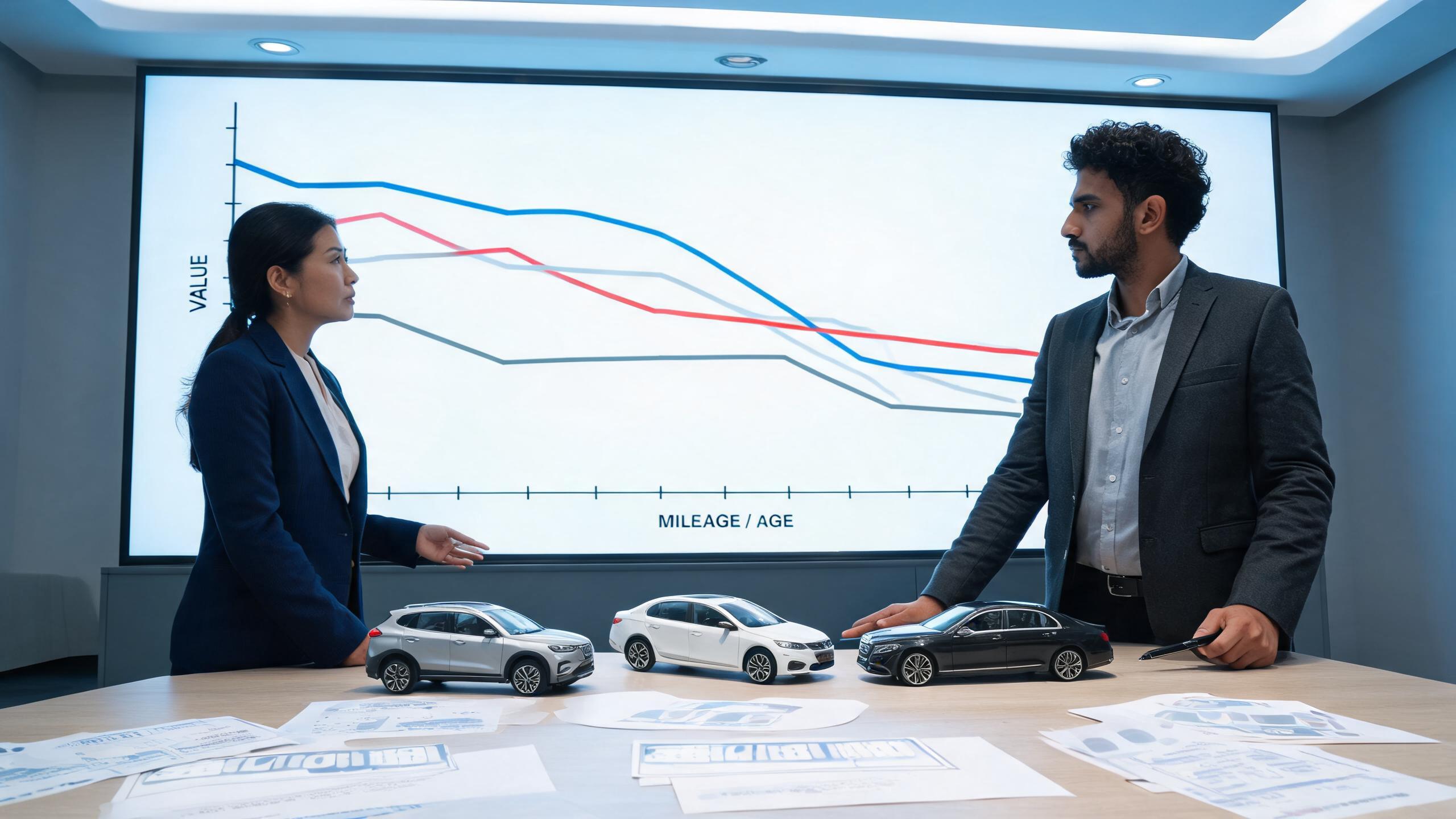

Automotive analysts studying depreciation curves and mileage data, showing why used-car values fall unevenly for consumers trying to find underpriced used cars.

Why Value Falls Unevenly

Understanding Car Depreciation

Depreciation is not a smooth staircase. It is a series of drops triggered by age, mileage, incentives, fuel prices, and fear. The biggest decline typically arrives early, when a new car becomes a used car and loses the factory-fresh premium that buyers pay for untouched mileage and full warranty runway.

Industry valuation guides such as Kelley Blue Book, Black Book, Cox Automotive data, and auction lane reports tend to show the same broad pattern: many new vehicles lose roughly 20% of value in the first year, then continue declining at a slower but still painful pace through years two, three, and four. Five-year depreciation often lands around the high-30% to mid-40% range, though the spread between models can be enormous.

"A cheap car with a slipping transmission is not cheap. It is tuition."

Supply is the quiet force behind much of that spread. A low-volume body-on-frame SUV with a loyal following can stay firm while an overproduced sedan with heavy rental-fleet exposure softens fast. Incentives matter too. If manufacturers put thousands of dollars on the hood of new models, late-model used examples must adjust downward or sit.

Mileage creates another cliff. A vehicle crossing 60,000 miles may leave bumper-to-bumper warranty coverage behind; at 100,000 miles, some shoppers simply disappear from the audience. Condition then amplifies everything. Two identical 2019 Toyota Camrys can differ by thousands of dollars if one has service records, matching tires, clean paint, and no accident entry on the vehicle history report while the other smells like wet gym socks and has mismatched body panels. Knowing how to read a vehicle history report and catch red flags before signing protects both buyers and sellers.

The Vehicles That Tend to Hold Value Best

Resale strength is rarely accidental. Toyota Tacoma, Toyota 4Runner, Jeep Wrangler, Honda CR-V, Subaru Crosstrek, and select full-size pickups have historically held value well because they combine utility, brand reputation, manageable ownership costs, and steady demand. Hybrids also gained ground as fuel prices remained unpredictable and buyers started viewing efficiency as a hedge rather than a niche preference. Review Used Toyota 4Runner inventory to see examples of a model known for strong resale value.

Electric vehicles are trickier. Tesla Model 3 and Model Y prices demonstrated how quickly depreciation can accelerate when new-vehicle prices are cut, tax-credit eligibility changes, or used EV supply expands. Battery health, charging access, and federal incentive rules all influence buyer confidence. A used EV can be a bargain; it can also be a fast-moving depreciation case study.

Wholesale, Auctions & Realistic Expectations

Wholesale Car Buying for Consumers in the USA

Wholesale channels shape every retail offer, even when the consumer never sees the auction lane. Dealers use Manheim, ADESA, local auctions, closed manufacturer sales, and direct-from-consumer acquisition tools to determine what they can pay. Those wholesale signals ripple into trade-in values within days, sometimes hours, when the market moves sharply.

For shoppers looking at wholesale used cars for sale, the attraction is obvious: buy below retail, avoid dealer markup, maybe find underpriced used cars before everyone else notices. The catch is that wholesale inventory often carries less disclosure, shorter arbitration windows, transportation costs, buyer fees, and reconditioning needs that a retail buyer may underestimate.

Wholesale car auctions for consumers exist, but access rules vary. Many dealer-only auctions require a dealer license, while some public auctions, government surplus sales, repossession auctions, and online platforms allow non-license buyers. The phrase "buy auction cars without license" gets searched constantly because consumers want dealer-style sourcing power. Fair enough. But auction rules in the USA are fragmented, and every state has its own licensing, title, sales tax, and temporary tag requirements.

Price vs. Total Landed Cost

Add buyer fees, transportation, post-sale inspection, title processing, emissions compliance, registration, tires, brakes, fluids, and the possibility of no meaningful warranty. VirtualCarHub.com often frames this as a simple discipline: if you cannot estimate recon and title risk, you do not yet know the price.

That same discipline applies when selling your current car. If your vehicle is desirable enough that dealers are competing for it, wholesale knowledge helps you negotiate. If auction data suggests your model is sliding because rental units are flooding the market, waiting another month may be expensive. Market literacy is leverage — a point explored further in the depreciation math that really decides the deal.

Best Practices Before Chasing an Auction Bargain

  1. Verify whether the auction is public, dealer-only, salvage, government, or lender repossession.
  2. Read the title status. Clean, rebuilt, flood, lemon buyback, and odometer brands are not minor footnotes.
  3. Budget reconditioning before bidding, not after winning.
  4. Use VIN history, inspection reports, and market comps from retail and wholesale sources.
  5. Know your state paperwork deadlines, especially for title transfer and sales tax remittance.

Which Vehicles Hold Value Best — and How to Time Your Exit

The strongest resale performers usually share three traits: constrained supply, durable reputation, and a buyer base that needs the vehicle rather than merely likes it. Work trucks, off-road SUVs, compact crossovers, and fuel-efficient hybrids fit that pattern better than luxury sedans with complex electronics and steep warranty anxiety.

Pickup trucks deserve special attention. A three-quarter-ton diesel in clean condition can command stout money in rural markets, construction corridors, and states where towing is part of daily life. A compact truck such as a Tacoma has a different audience but a similar resale story: buyers believe it will run forever, and belief moves money. Full-size trucks can depreciate more unevenly because incentives on new models, fuel prices, and trim complexity create bigger price swings. See Used Toyota Tacoma inventory for examples of the compact truck discussed here.

"Depreciation is not destiny. It is market mechanics."

Regional nuance is underrated. Weather splits the USA into different used-car economies. Rust belt buyers scrutinize undercarriages. Sun Belt buyers worry about faded paint and cooked interiors. Colorado and the Pacific Northwest reward all-wheel drive and outdoor-capable crossovers. In parts of Texas, heavy-duty pickups can behave like local currency. In dense coastal cities, parking size and fuel cost change the resale conversation.

Timing also affects value. Convertibles often bring stronger money before warm weather. Four-wheel-drive SUVs gain attention before winter. Tax refund season can support demand for affordable used cars, while year-end new-car incentives may pressure late-model used pricing. If your vehicle is approaching a major mileage threshold or warranty expiration, selling before the psychological cliff can preserve value. Browse Used Convertibles inventory when considering seasonal timing for a convertible sale.

A Practical Seller Playbook

  • Pull a vehicle history report before buyers do, and fix any clerical title or mileage errors early.
  • Detail the car, but do not hide defects. Sophisticated buyers spot fresh undercoating and mystery warning-light resets.
  • Gather maintenance records, original window sticker, extra keys, and payoff information.
  • Price against similar mileage, trim, drivetrain, accident history, and regional demand.
  • Get at least two trade-in offers and one private-sale valuation before deciding.

Before accepting any number, identify your real objective. Maximum proceeds? Minimal hassle? Fast payoff before the next loan payment hits? A clean exit from a vehicle that may need $1,800 in suspension work soon? The best selling channel is the one that turns market value into collected money with the least leakage.

The trade-in versus private-sale decision is not a morality test, and depreciation is not destiny. It is market mechanics. Learn the mechanics, watch the local data, and choose deliberately. The seller who understands both retail emotion and wholesale reality is usually the seller who leaves less money on the table.

Browse current inventory

Frequently asked questions

When is a trade-in a better choice than a private sale?

A trade-in can be better when reduced hassle, faster payment, tax credits, and lower post-sale exposure outweigh the potentially higher gross proceeds of a private sale.

Why does a private sale often bring more money?

Private sale usually wins on gross proceeds because you are selling closer to retail value. The seller must prepare the vehicle, manage appointments, and protect against payment and title-transfer risks.

How much value does a new car typically lose?

Many new vehicles lose roughly 20% of value in the first year. Five-year depreciation often lands around the high-30% to mid-40% range, though the spread between models can be enormous.

Which vehicles have historically held value well?

Toyota Tacoma, Toyota 4Runner, Jeep Wrangler, Honda CR-V, Subaru Crosstrek, and select full-size pickups have historically held value well. Hybrids also gained ground as fuel prices remained unpredictable.

What affects the value of a used electric vehicle?

Battery health, charging access, and federal incentive rules all influence buyer confidence. Used EV prices can also change quickly when new-vehicle prices are cut or used EV supply expands.

Related Articles