How to Transfer a Car Title

A First-Time Car Buyer's Complete Guide to Paperwork, Delivery, and Avoiding Costly Mistakes

AUGUST 2026 EDITION

Title Transfer Basics

Buying your first car feels thrilling right up until someone slides a stack of paperwork across the table and starts using phrases like “lien release,” “odometer disclosure,” and “title reassignment.” Suddenly the shiny used SUV in the driveway seems less important than whether you filled in Box B instead of Box C.

Relax. Title transfer isn’t glamorous, but it’s manageable when you know the sequence. I’ve watched buyers lose a Saturday at the DMV over one missing seller signature, and I’ve seen clean deals wrap up in twenty minutes because every document was ready before money changed hands. The difference is preparation.

This guide walks you through how to transfer a car title in the USA, what first-time buyers need before paying for a vehicle, how online buying and car delivery to home fit into the process, and where people usually trip. We’ll cover private-party purchases, dealer transactions, financed cars, auction vehicles, and the odd little state rules that can make or break your day.

What You're Actually Doing

A vehicle title is the legal ownership document for a car, truck, SUV, van, or motorcycle. Registration lets you drive it on public roads. Insurance protects you financially. The title says who owns the vehicle. Don’t blur those together; plenty of first-time buyers do, and that confusion can get expensive. Reviewing the title is especially important when comparing Used SUVs, because the document must identify the vehicle and its owner.

When you transfer a title, the seller releases ownership and the buyer applies for a new title through the state motor vehicle agency. In some states it’s called the DMV. Elsewhere it might be the BMV, MVD, RMV, DOL, or Department of Revenue. Same basic job. Different counter signs, different forms, different patience levels required.

The core process is usually simple: inspect the title, confirm the VIN, verify the seller’s identity, complete the assignment section, record the odometer reading if required, pay the seller, and submit the documents with taxes and fees by your state’s deadline. Simple, though not always easy.

"Never hand over full payment until you’ve physically reviewed the title or confirmed the dealer’s title process in writing."

Here’s the first rule I give new buyers: never hand over full payment until you’ve physically reviewed the title or confirmed the dealer’s title process in writing. A promise that “the title’s coming next week” can be harmless at a franchised dealership with proper back-office controls. From a stranger in a grocery-store parking lot? No. Walk away if the story smells weird.

Most states require title transfer within a set window after purchase. Ten, fifteen, twenty, or thirty days are common deadlines, but don’t guess. Late fees can pile up, and in some places you can’t properly register the vehicle until the title application is underway. If you’re buying across state lines, check both states before signing anything. For a deeper walkthrough, see our companion first-time car buyer's complete paperwork guide.

The Documents First-Time Buyers Usually Need

  • Original vehicle title, properly signed by the seller and buyer where required.
  • Bill of sale, especially for private-party purchases or states that use it to calculate tax.
  • Government-issued photo ID.
  • Proof of auto insurance that meets your state’s minimum coverage rules.
  • Odometer disclosure for vehicles covered by federal and state mileage reporting rules.
  • Lien release if the title shows a lender and the loan has been paid off.
  • Registration/title application from your state motor vehicle agency.
  • Emissions or safety inspection certificate if your county or state requires one.
  • Payment for sales tax, title fee, registration fee, plate fee, and local add-ons.

Federal odometer rules now generally require mileage disclosure for vehicles less than 20 model years old, a change phased in after years of the old 10-year standard. States may add their own paperwork habits on top of that. Don’t leave the mileage blank unless your DMV specifically says the vehicle is exempt.

And yes, taxes are part of the deal. In most of the USA, you’ll pay sales or use tax when applying for title and registration, even if you bought the car from your uncle for cash. Some states calculate tax from the sale price; others may question suspiciously low prices and use book value. Writing “$1” on a bill of sale for a $17,000 Camry is not clever. It’s an invitation.
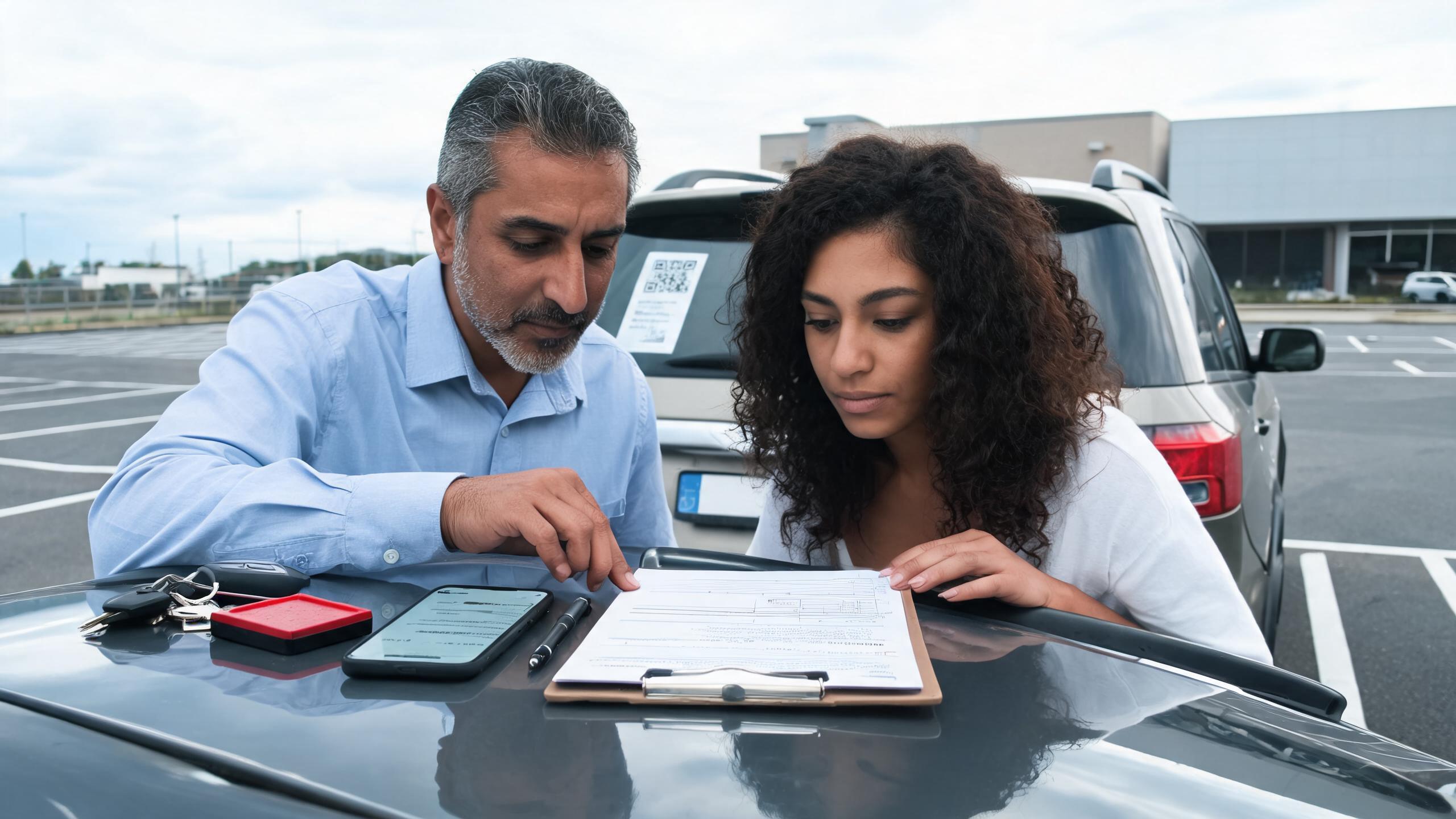

Buyer and seller checking VIN and title paperwork step by step before completing a used car purchase

Step-by-Step After You Buy

Before you meet the seller, ask for a photo of the front and back of the title with personal information partially covered if they’re cautious. You’re looking for basics: VIN, year, make, model, owner name, lienholder, brand history, and whether the title looks altered. Torn edges, white-out, mismatched ink, or a seller name that doesn’t match the ID all deserve a pause.

Then match the VIN on the title to the vehicle. Check the dashboard plate near the windshield, the driver-side door jamb sticker, and the VIN shown in any vehicle history report. If those numbers don’t match perfectly, stop. Not “ask for a discount.” Stop. VIN problems can point to clerical errors, theft, rebuilt vehicles, or title washing. Learning how to read a vehicle history report before you negotiate helps you spot these red flags early.

Once the car passes inspection and you’re ready to buy, complete the title assignment section exactly as your state requires. Use legal names, not nicknames. Write the sale date clearly. Enter the odometer reading without rounding. If the title has two owners joined by “and,” both may need to sign. If it says “or,” one signature may be enough. That tiny conjunction matters more than it should.

Notary Trap

Many states require notarization for private-party title transfers. Pennsylvania, North Carolina, Ohio, and several others have notary rules that catch out-of-state buyers by surprise. Don’t sign a title early if notarization is required; the notary usually needs to witness the signature. I’ve seen buyers turn a clean transaction into a two-day chase because the seller signed at breakfast and the notary refused it at lunch.

Pay in a traceable way when possible. Cashier’s checks, bank wires, or meeting at the seller’s bank can reduce risk on higher-dollar purchases. If you use cash, get a detailed bill of sale with the VIN, sale price, date, buyer and seller names, addresses, and signatures. Take photos of the signed paperwork before leaving. Paper disappears. Phones save the day.

Your Practical Title-Transfer Checklist

  1. Confirm the seller’s name matches the title and ID.
  2. Check for liens, salvage brands, flood brands, rebuilt status, or odometer discrepancies.
  3. Match the VIN on the title, vehicle, history report, and bill of sale.
  4. Complete the title assignment with no blanks in required fields.
  5. Record mileage accurately if disclosure applies.
  6. Get notarization before anyone leaves if your state requires it.
  7. Secure a lien release if a lender appears on the title.
  8. Buy insurance before driving the vehicle home.
  9. Submit title and registration paperwork before your state deadline.
  10. Keep copies of everything: title front/back, bill of sale, inspection, payment receipt, and DMV forms.

If you’re buying from a dealership, the store typically handles title and registration paperwork, collects taxes and fees, and files with the state. That’s one reason many first-time buyers prefer dealers, especially if they’re financing. Still, ask two direct questions: “When will my title and registration be submitted?” and “What temporary tag or permit do I use until plates arrive?” Good dealers answer without flinching. Dealers handling title paperwork can also help buyers compare Used Trucks with the required taxes, fees, and registration costs.

Private-party purchases put more responsibility on you. Some states require the seller to remove plates; others let plates stay with the car. Some require the seller to file a release of liability right away. In California, for example, sellers commonly submit a notice of transfer and release of liability; in Texas, buyers need to be mindful of title application timing and vehicle inspection rules. Regional differences are not trivia. They’re the rules of the road.

Online, Delivery & Auctions

The car-buying landscape has changed. More shoppers want to skip the dealership car buying routine: no fluorescent showroom, no waiting for the “manager,” no awkward coffee in a paper cup while finance prints another form. Online retailing has made that possible, and car delivery to home in USA markets has moved from novelty to expectation in many metro areas. Online shoppers comparing Used Coupes should still confirm how title transfer, delivery, and registration will be handled.

But paperwork still matters. Whether you buy from a local dealer, a national online retailer, or a platform like VirtualCarHub.com that helps buyers compare inventory and purchase paths, title transfer must land correctly with your state. A car can arrive spotless on a flatbed and still create headaches if the title packet is incomplete.

For online purchases, ask how the seller handles identity verification, electronic signatures, temporary tags, state sales tax, registration, and title delivery. If you live in Arizona but buy a vehicle located in Georgia, the seller may need to collect your home-state tax, arrange transport, and process paperwork through a third-party registration service. Or they may hand certain steps back to you. Get that spelled out before the deposit.

"A car can arrive spotless on a flatbed and still create headaches if the title packet is incomplete."

Delivery adds another wrinkle: when does ownership transfer? At signing? At pickup? At drop-off after inspection? Read the purchase agreement. If you have a return window, understand mileage limits, damage rules, and whether title application starts immediately or after the return period expires. The cleanest online retailers explain this plainly because they’ve learned, usually the hard way, that confused buyers call a lot.

Now, about auctions. People search for how to buy car from Manheim because Manheim is one of the largest wholesale auto auction networks in the country. Here’s the catch: Manheim is generally dealer-only. That means regular consumers can’t simply create an account, walk in, and bid like they’re buying patio furniture online. Dealer only car auctions explained in one sentence? They’re wholesale marketplaces where licensed dealers, fleet companies, rental firms, banks, and remarketers buy and sell inventory under auction rules.

Can a first-time buyer access auction vehicles indirectly? Sometimes. A licensed dealer, broker, or buying service may purchase on your behalf. But go slowly. Auction vehicles are often sold under condition reports, arbitration policies, and title status categories that don’t feel friendly to beginners. “Title absent” does not mean “no big deal.” It means the title isn’t currently available at sale time, and delays can happen.

Questions to Ask Before Buying Online

  • Is the title in hand, electronic, pending, or absent?
  • Will the vehicle be titled in my state before or after delivery?
  • Who collects sales tax and registration fees?
  • Are temporary tags valid in my state and along the delivery route?
  • What happens if the DMV rejects paperwork?
  • Is there a return policy, and does title work pause during that period?
  • Does the vehicle have any announced frame damage, flood history, salvage brand, lemon-law buyback, or odometer issue?

The best deals on used cars online aren’t always the cheapest listings. A $1,200 savings can vanish fast if you need duplicate-title work, emissions repairs, transport rebooking, or legal help because the seller skipped a lien release. Look for clean documentation, transparent fees, realistic photos, and a seller that doesn’t dodge paperwork questions.

From the retailer side, this is where Automotive Retail professionals earn trust. Clear title status labels, accurate fee menus, DMV deadline reminders, scanned document previews, and proactive delivery updates reduce friction. The stores that do this well don’t just sell cars; they remove dread. That’s more valuable than another stock photo of someone holding keys.

Fraud, Liens, and Costly Mistakes

Title fraud thrives on urgency. “I have three other buyers coming.” “My cousin has the title.” “The bank already released it, I just don’t have the paper.” Maybe true. Maybe not. Either way, slow down when the paperwork gets fuzzy.

Title washing is one of the nastier tricks in used-car retail. A vehicle branded as flood, salvage, rebuilt, or junk in one state may be moved through another jurisdiction in an attempt to obscure its history. Modern databases have improved, and the National Motor Vehicle Title Information System helps, but no system is magical. Use a vehicle history report, inspect the physical title, and consider a pre-purchase inspection from a qualified technician.

Flood vehicles deserve special attention, especially after hurricanes and severe storms along the Gulf Coast, Atlantic states, and parts of the Midwest. Water damage can hide under carpet padding, inside connectors, behind trim panels, and in control modules. If a car smells like a damp basement sprayed with vanilla air freshener, trust your nose. Electronics don’t forgive saltwater.

Liens are another common snag. If a lender is listed on the title, the seller doesn’t fully control the transfer until the lien is satisfied and released. At a dealer, payoff departments handle this routinely. In a private sale, meet at the lender’s branch if possible, confirm payoff procedures, and don’t assume a handwritten receipt equals a lien release. It usually doesn’t.

"The pressure to be 'nice' causes many bad car deals. Paperwork doesn’t care about nice."

Name mismatches create boring but brutal problems. If the seller’s married name differs from the title, if an estate is involved, if a company owns the vehicle, or if two owners are listed and only one shows up, you need extra documentation. Death certificates, letters of administration, powers of attorney, corporate authorization, divorce documents — yes, it can get that formal. Better to know before you drive two hours with a cashier’s check.

Common Title-Transfer Mistakes and Quick Fixes

  • Missing seller signature: ask the seller to sign in the correct assignment field before submission; don’t forge, ever.
  • Wrong buyer name: contact your DMV before altering anything. Some states require a correction form or duplicate title.
  • Odometer written incorrectly: use your state’s odometer correction process. Cross-outs can void a title.
  • Lien still showing: obtain an official lien release on lender letterhead or state-approved form.
  • Late filing: submit immediately and be prepared for penalties; don’t keep driving on expired temporary tags.
  • Title signed by the wrong person: verify authority through power of attorney, estate paperwork, or business records.

Dealers face a parallel version of these headaches. Title clerks are the quiet heroes of Automotive Retail, because one missed reassignment or late payoff can stall funding, delay plates, and sour a customer who otherwise loved the vehicle. Best practice is boring on purpose: same-day document scanning, lien payoff tracking, title-aging reports, strict VIN verification, and clean handoffs between sales, F&I, accounting, and registration vendors.

For buyers, the practical standard is simpler: if the title has a brand, a lien, an error, a missing signature, or a seller story that keeps changing, don’t be embarrassed to pause.

Your First-Time Buyer Game Plan Before You Sign

Start with budget, not inventory. The purchase price is only the loudest number. Add sales tax, title and registration fees, documentation fee, inspection costs, insurance, transportation, maintenance catch-up, and interest if you finance. A first-time buyer who can afford a $19,000 car may not be able to afford that same car at $450 per month after tax, warranty, GAP, and a high APR.

Get insurance quotes before choosing the vehicle. A sporty coupe, a full-size pickup, and a compact crossover can produce wildly different premiums for the same driver. In states with high insurance costs — think Florida, Michigan, Louisiana, or parts of New York — the premium may change your buying decision. That’s not fun. It is reality.

Arrange financing before you shop seriously. Credit unions, banks, and online lenders can give you a benchmark rate, even if you eventually finance through a dealer. Preapproval helps you separate the car deal from the loan deal, which is especially useful when excitement starts doing its little tap dance in your brain. Our practical paperwork guide and first-time buyer playbook lays out the sequence in even more detail.

Inspect the vehicle like you’re mildly suspicious. Because you should be. Check tires for uneven wear, look under the oil cap, test every window and switch, scan for warning lights, confirm air conditioning blows cold, and drive at neighborhood and highway speeds. If you’re spending serious money, pay for a pre-purchase inspection. A $180 inspection can save you from a $4,000 transmission lesson.

Buying Remotely?

Request a live video walkaround. Ask the seller to start the car cold, show the VIN plate, scan the undercarriage, demonstrate electronics, and point the camera at tire date codes. Reputable sellers won’t act offended. At VirtualCarHub.com, the buyer-first perspective is straightforward: confidence comes from visibility, not sales pressure.

A Simple First-Time Buyer Sequence That Works

  1. Set your total budget, including taxes, insurance, registration, and repairs.
  2. Get financing preapproval unless you’re paying cash.
  3. Research models for reliability, recall history, ownership costs, and regional needs.
  4. Compare dealer, private-party, certified pre-owned, and online inventory.
  5. Run a history report and check title status before negotiating hard.
  6. Inspect and test-drive the vehicle, or hire someone qualified to do it.
  7. Review the title, bill of sale, fees, warranty terms, and delivery agreement.
  8. Complete payment and paperwork only when ownership documents are clear.
  9. Submit title and registration forms by your state deadline.
  10. Store copies digitally and physically. Future-you will be grateful.

Regional needs matter in the USA more than buyers expect. In Colorado, an all-wheel-drive Subaru may command a premium before ski season. In Texas, trucks hold strong value but fuel and tire costs can bite. In the Northeast, rust inspection is non-negotiable. In California, emissions compliance can make or break registration. A good deal in one region can be mediocre somewhere else. Regional factors can affect the value and registration considerations of a Used Subaru, especially in Colorado before ski season.

After you file the title transfer, keep your temporary registration, bill of sale, insurance card, and DMV receipt in the car until plates and permanent documents arrive. If weeks pass with no update, call the DMV or the dealer before the temporary tag expires. Don’t wait until a police officer is standing at your window asking why your permit died three days ago.

Here’s the plain truth: buying your first car is part transportation decision, part legal transaction, part emotional obstacle course. The title is where all three collide. Treat the paperwork with the same seriousness you give the test drive, and you’ll avoid most of the traps that punish new buyers.

You don’t need to become a DMV expert. You just need a clean title, a verified seller, accurate forms, insurance in place, and a state-specific filing plan. Do that, and the keys in your hand actually mean what you think they mean: the car is yours.

Browse current inventory

Frequently asked questions

What documents should I review before paying for a used car?

Review the physical title or confirm the dealer’s title process in writing. Check the VIN, owner name, lienholder, brand history, odometer requirements, and required signatures.

Who handles title and registration paperwork when buying from a dealership?

The dealership typically handles title and registration paperwork, collects taxes and fees, and files with the state. Ask when the paperwork will be submitted and what temporary tag or permit you should use.

What happens if a lender is listed on the vehicle title?

The seller does not fully control the transfer until the lien is satisfied and released. In a private sale, confirm payoff procedures with the lender and do not assume a handwritten receipt is a lien release.

What should I do after filing the title transfer?

Keep your temporary registration, bill of sale, insurance card, and DMV receipt in the car until the plates and permanent documents arrive. If there is no update before the temporary tag expires, contact the DMV or dealer.

Related Articles