Buying a Used Car Out of State

Sales Tax, Title and Registration, Step by Step

SEPTEMBER 2026 EDITION

The Bargain That Turns Into a DMV Marathon

The bargain usually looks clean at first. A lower-mileage SUV in Ohio. A rust-free pickup in Arizona. A one-owner sedan listed hundreds of miles from home. Then the paperwork starts, and the whole thing shifts. Sales tax, title transfer, temporary tags, emissions rules, lender releases, county fees—buying a used car out of state can turn from smart shopping into a DMV endurance test the moment you treat it like an ordinary local purchase.

Across the USA, more than 35 million used vehicles change hands in a typical year. Shoppers increasingly look past their own ZIP code because inventory is uneven and prices still carry the scars of pandemic-era supply shortages. A Midwest buyer might cross into Indiana for a truck. A New Yorker may find better selection in Pennsylvania. A California family might chase a specific hybrid in Nevada, only to learn that registration compliance is the real exam.

The core principle is simple, even if the execution rarely is. You generally owe tax where the vehicle will be registered, not merely where you found it. From there, every state adds its own small traps: deadlines, inspection sequencing, notarization quirks, local surtaxes, VIN verification rules, title-brand scrutiny. Miss one, and your new-to-you car sits in the driveway wearing expired paper tags while your application bounces between agencies.

"The tax is tied to use and registration. Not the thrill of crossing a border."

You Pay Where You Register

The first myth to kill is tax arbitrage. Buying in a lower-tax state rarely lets you escape your home-state obligation. Most states impose sales tax, use tax, or a motor-vehicle excise tax when you title and register the car. If the seller didn't collect tax at purchase—or collected less than your home state requires—the DMV or revenue department will usually collect the balance before handing over plates.

That's why a vehicle advertised as tax-free can still be expensive at the counter. A private seller in Oregon may not collect sales tax. A dealer in another state may collect nothing if the vehicle is being transported out. But if you live somewhere with a 6%, 7%, or higher combined rate, the bill usually follows you home.

Many states offer credit for tax properly paid elsewhere, though only up to the amount your home state recognizes. Pay 5% in the selling state and owe 7% at home, and you'll likely be charged the 2% difference. Pay more than your state requires? Refunds aren't always automatic. Sometimes they're not available at all without a separate revenue claim, original receipts, and patience measured in months. If you are shopping now, browse the Used SUVs currently available.

State systems vary sharply. New York combines state and local sales tax rates based on your registration address. California starts with a statewide base rate, layers on district taxes, and scrutinizes emissions eligibility on top of that. Texas charges a motor vehicle sales and use tax when the vehicle is titled. Florida applies its own sales tax and discretionary surtax rules. Illinois treats dealer and private-party transfers differently. None of this is a footnote. It affects the check you write.

Regional tax wrinkles buyers miss

In the Northeast, the friction usually comes from dense local tax structures, emissions checks, and short title timelines. Down South, an apparently favorable state rate can be offset by county fees, documentation charges, or inspection requirements. Western states bring a different headache: emissions and California Air Resources Board compliance may decide whether the car can be registered at all. In the Midwest, where borders sit close and price gaps can be meaningful, buyers often shop across state lines without realizing the paperwork burden shifts to them the moment they bypass a local dealer.

  • Check your home state DMV and department of revenue before negotiating price, not after.
  • Ask whether tax is calculated on purchase price, fair market value, book value, or a state schedule.
  • Confirm whether county or city surtaxes apply to the registration address.
  • Keep the buyer order, bill of sale, wire receipt, and any tax receipt in one folder. Digital copies help, but some agencies still want originals.

The painful surprise is rarely the tax rate itself. It's the timing. Buyers budget for the purchase, the shipping, the insurance—then discover that tax must be paid in one lump sum before the title application even moves forward. On a $28,000 used SUV, even a 7% obligation means $1,960 due at registration, before plate fees or inspections.

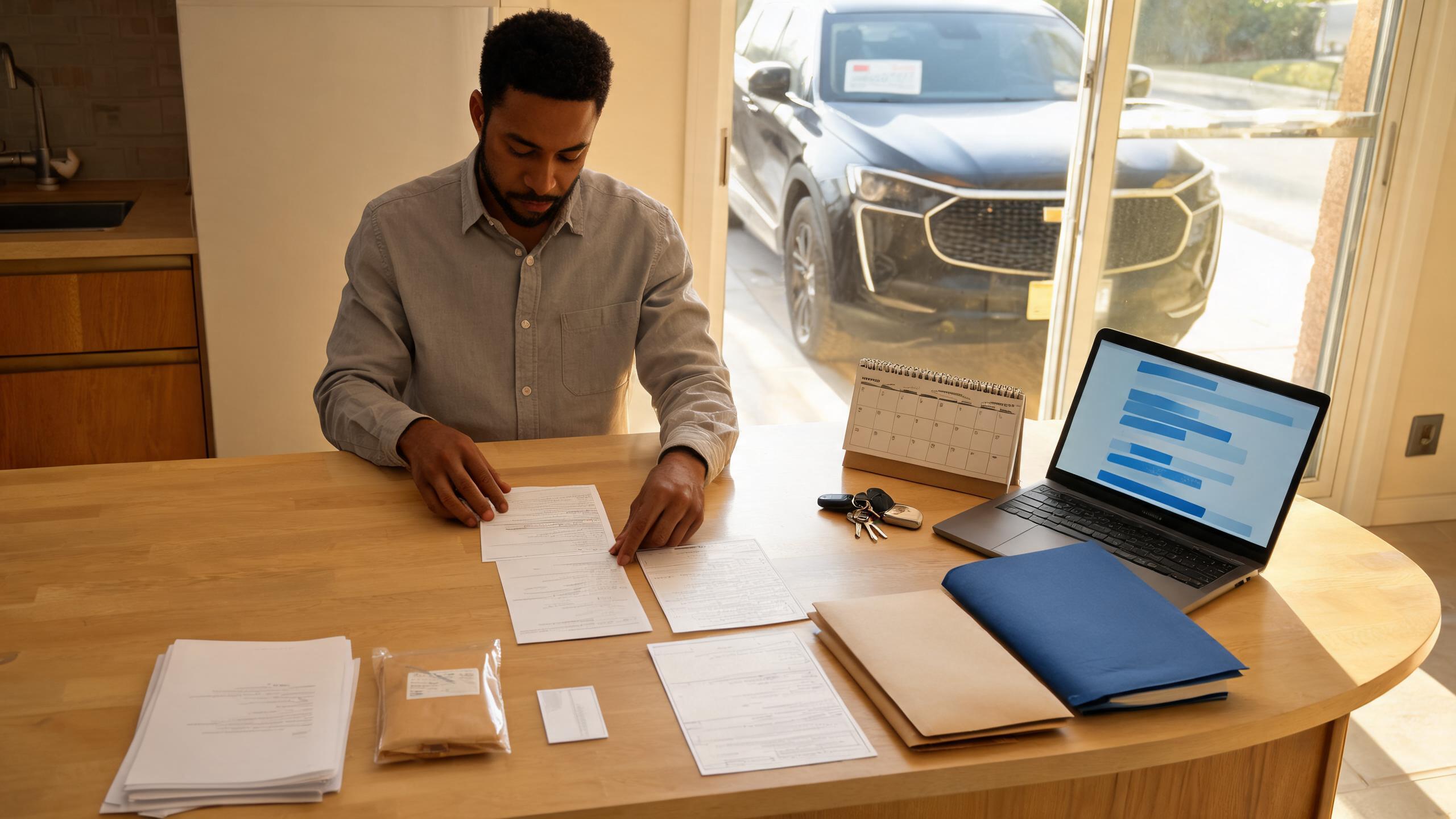
Buyer organizing sales tax, title, insurance, temporary tag, and registration documents for car buying without sales pressure.

Paperwork Before Payment: Title, Lien Release, and Original Condition Used Cars

The title is the vehicle's passport. If it's missing, branded, incorrectly assigned, still held by a lender, or signed in the wrong place, the transaction can freeze no matter how nice the car looks in photos. Out-of-state buying magnifies every title defect, because you can't always drive back to the seller's kitchen table to fix a skipped signature.

Start by confirming whose name is on the title. The seller should match the titled owner unless a licensed dealer is processing reassignment paperwork. If there's a lien, identify the lienholder, the payoff amount, the release method, and the expected mailing timeline. A seller who says the bank has the title may be telling the truth. That doesn't make the car ready to register. If you're new to this dance, our first-time buyer's guide to transferring a car title walks through the sequence in plain language.

Federal odometer rules matter too. For model year 2011 and newer vehicles, odometer disclosure generally stays required for 20 years—a change that extended the old 10-year framework. States handle that disclosure through title forms, secure dealer documents, or separate statements. A missing mileage certification can stop a title application cold. So can erasures, white-out, altered dates, or a mileage entry that fights with the vehicle history report. If you are shopping now, browse the Used Trucks currently available.

Here's where original condition used cars deserve a sober conversation. Plenty of buyers prefer vehicles before retail cosmetic work, because they can read the wear honestly: stone chips, seat bolster use, tire age, brake condition, light hail, a bumper scuff. Retail lots often fold a reconditioning markup into the advertised price after paintwork, dent repair, wheel refinishing, interior dye, nitrogen packages, and sealants. Some of that work is useful. Some of it just makes a wholesale car photograph better.

A Cheap Unit With a Muddy Title

Dealer-only auction channels can reveal vehicles closer to their trade-in state, which is valuable when inspection standards are disciplined. But raw access isn't enough. You need condition reports, frame and paint checks, diagnostic scans when available, tire and brake readings, title-brand review, and a hard look at transport damage risk. A cheap unit with a muddy title isn't a deal. It's a file problem with wheels.

Documents to secure before money moves

  1. Current certificate of title, front and back, with the titled owner clearly identified.
  2. Bill of sale showing buyer, seller, VIN, purchase price, date, and vehicle description.
  3. Odometer disclosure when required by federal and state rules.
  4. Lien release or payoff letter, plus proof the release arrives in the form your state accepts.
  5. Dealer reassignment forms if a licensed dealer is involved and the title isn't assigned directly on the certificate.
  6. Temporary tag or transit permit documentation, including the issuing state and expiration date.
  7. Emissions, safety inspection, or VIN verification forms if your home state requires them before registration.
  8. Insurance binder effective before pickup, transport, or delivery.

Private-party deals demand extra caution. Some states require notarized signatures. Others require sellers to pull plates immediately. A handful get fussy about ink color, date order, or whether a purchaser's name can be abbreviated. It sounds absurd until your paperwork gets rejected for a clerical mistake made 900 miles away.

"A cheap unit with a muddy title isn't a deal. It's a file problem with wheels."

The Ten Steps After You Buy

Once you agree to buy, the clock starts. Registration deadlines commonly land somewhere between 10 and 60 days after purchase, residency, or vehicle entry into the state, though the exact trigger differs. Temporary tags may expire sooner. Lenders may want proof of a perfected lien. Insurance companies may want the registration updated. Everybody wants a document from somebody else.

  1. Verify eligibility before pickup. Check the VIN for title brands, open liens, recalls, emissions compatibility, and whether the car can even be registered in your state. A clean history report helps. It isn't a title guarantee.
  2. Calculate tax using your registration address. Use your home DMV or revenue calculator when one exists. Fold in local surcharges, title fees, plate fees, inspection fees, and any electric or hybrid registration charges.
  3. Arrange payment through a traceable method. Wire transfers, cashier's checks, and escrow-style processes beat casual payment apps for high-dollar buys. Don't release full funds until title logistics are clear.
  4. Secure insurance before the car moves. Most states demand proof of coverage before issuing plates, and transport companies often ask for delivery contacts and coverage details.
  5. Decide whether to drive or ship. Driving may require a temporary tag from the selling state, a transit permit from your home state, or both. Shipping sidesteps some road-legal issues but solves nothing on the title or tax side.
  6. Collect originals and scan everything. Photograph the title before it leaves anyone's hands. Send title documents by trackable mail. Save bills of lading and delivery condition photos.
  7. Complete required inspections. Some states require VIN verification for out-of-state vehicles. Others need emissions or safety inspection before plates go on, or shortly after registration.
  8. Submit title and registration forms promptly. Bring proof of tax paid, bill of sale, title, lien release, odometer statement, insurance, ID, and any inspection certificates.
  9. Pay remaining tax and fees. The agency calculates on its rules, not your spreadsheet. If the purchase price reads below market, some states ask for extra documentation.
  10. Track the title. With a lienholder involved, confirm your lender is recorded correctly. Paid cash? Make sure the title lands in your name, and store it somewhere safer than the glove box.

Temporary tags deserve their own warning. A tag valid in the selling state may not be honored the same way once you cross several jurisdictions. Police practices vary, toll systems don't always read paper tags, and an expired transit permit can lead to impoundment in the wrong circumstance. If the trip home crosses four states, plan like a dispatcher, not a tourist.

Inspections can wreck the timeline too. A truck bought in rural Georgia might be mechanically sound yet fail emissions in a metro county elsewhere. A performance car from a lenient-testing state may need factory emissions equipment restored before it can register. A California-bound vehicle can trigger special scrutiny if it lacks the right emissions labeling or has fewer than the required miles for certain used-vehicle exemptions. The West doesn't play around.

Financing adds one more layer. Lenders care about lien perfection, title receipt, and accurate registration. If the seller's title is delayed, your loan can slip into exception status. If the VIN is entered wrong, the lien may not attach cleanly. And if you're buying through auction-related channels, make sure the party collecting funds is authorized to transfer ownership and complete reassignment documents. For the mechanics of that handoff, this practical paperwork guide and first-time buyer playbook is worth a read before you sign anything.

Common rejection reasons at the DMV

  • Seller signed on the wrong line or used a nickname instead of the legal name on title.
  • No lien release, or a release your state won't accept.
  • Purchase price omitted, altered, or inconsistent across forms.
  • Out-of-state inspection completed in the wrong sequence.
  • VIN verification missing for a vehicle never titled in your state.
  • Salvage, rebuilt, flood, odometer, or lemon-law brand not disclosed early enough.
  • Temporary tag expired before you submitted registration paperwork.

The fix isn't glamorous. Build a paperwork checklist and follow it with slightly obsessive discipline. Call the DMV twice if you have to. Different clerks describe the same rule differently, and state websites rarely account for real-world cross-border purchases. If you are shopping now, browse the Used Sedans currently available.

Dealership-Free Car Buying in the USA: Cutting Cross-Border Risk

Out-of-state buying isn't inherently risky. Casual out-of-state buying is. The professional version looks more like procurement than shopping: define the target vehicle, verify market value, inspect condition before you commit, control payment, manage documents, and register inside the deadline. No balloons. No four-square worksheet. No mysterious window-etching add-on surfacing after you already shook hands.

That's the appeal of dealership-free car buying in USA markets where consumers want access to wholesale inventory without walking a retail lot. VirtualCarHub.com, for example, works from the buyer's side—sourcing used cars, trucks, and SUVs through dealer-only auction channels, arranging inspections, and handling financing, paperwork, and delivery without commissioned salespeople or retail-lot markup. The goal isn't to make every vehicle cheap. It's to make the cost stack visible before you're emotionally trapped.

Car buying without sales pressure changes the whole rhythm. You can compare auction condition reports against retail listings. You can weigh whether used cars without dealer add ons are worth seeing the cosmetic flaws before they're dressed up. You can price transport against a fly-and-drive trip. Above all, you can calculate the delivered, taxed, titled, registered cost instead of celebrating an artificially low sticker.

Best practice starts with a landed-cost worksheet. Include acquisition price, buyer or auction fees if they apply, inspection, transport, sales or use tax, title fee, registration, plate transfer, emissions repair allowance, tires, brakes, key replacement, and a contingency line. That contingency isn't pessimism. It's adulthood. Used vehicles are machines with histories, and histories rarely arrive neatly alphabetized.

"The point isn't to make every vehicle cheap. It's to make the cost stack visible."

Professionals also split cosmetic reconditioning from mechanical readiness. A shiny bumper cover tells you nothing about subframe corrosion, transmission behavior, battery health, ADAS calibration, or prior structural repair. On late-model vehicles, a pre-purchase inspection should cover scan-tool data, service campaigns, tire date codes, brake measurements, paint-meter readings where appropriate, and any sign of water intrusion. For trucks and SUVs, undercarriage images matter—especially for vehicles from snow-belt states where road salt works slowly and without mercy.

The regional lens keeps mattering. A rust-free Arizona pickup can command a premium in Michigan. A Northeast hybrid might look attractively priced yet cost a fortune to register if the emissions equipment has been modified. A Florida vehicle can be clean and desirable, and still, watch for flood history and title-brand movement after major storms. In the USA, vehicle condition is partly geography. So is paperwork friction. If you want a deeper walkthrough of the handoff itself, this complete paperwork guide for first-time buyers covers the mechanics in detail.

Final checklist before you buy across state lines

  • Confirm your home-state tax rate and whether credit applies for tax paid elsewhere.
  • Verify title status directly, including liens and brands.
  • Check temporary tag rules for every state you'll drive through, or choose insured transport.
  • Review emissions, safety inspection, VIN verification, and county-specific registration requirements.
  • Budget for tax at registration, not just the advertised price.
  • Keep original documents protected and send title paperwork with tracking.
  • Don't ignore small inconsistencies. A wrong middle initial can become a week of delay.

Buying out of state can absolutely be worth it. Better selection, cleaner condition, rare trims, lower wholesale entry points—those advantages are real. The winning move is to treat sales tax, title, and registration as part of the purchase, not chores for later. The car isn't truly yours when you send the money. It's yours when the title is accepted, the tax is paid, the plates are legal, and the keys no longer come with an administrative headache.

Browse current inventory

Frequently asked questions

Where do I usually pay tax when buying a used car out of state?

You generally owe tax where the vehicle will be registered, not merely where you found it. If the seller collected less tax than your home state requires, the DMV or revenue department will usually collect the balance before issuing plates.

Can buying a car in a lower-tax state eliminate my home-state tax obligation?

Usually not. Most states impose sales tax, use tax, or a motor-vehicle excise tax when you title and register the car.

What should I check before buying a used car out of state?

Verify the title, odometer disclosure, vehicle condition, emissions eligibility, inspection requirements, payment process, and registration deadlines. A pre-purchase inspection should cover scan-tool data, service campaigns, tire and brake condition, paint readings, and signs of water intrusion.

How long do I have to register an out-of-state vehicle?

Registration deadlines commonly fall somewhere between 10 and 60 days after purchase, residency, or vehicle entry into the state, though the exact trigger differs. Temporary tags may expire sooner.

Related Articles