How to Transfer a Car Title: A Complete First-Time Car Buyer's Guide

Ownership, liens, taxes and paperwork — the checklist that protects your first purchase.

October 2026 · Car Title Transfer Edition

Buying your first car involves more than choosing a model and agreeing on a price. You also need to confirm who legally owns the vehicle, whether a lender still has a claim, which fees are due, and how your state wants the paperwork completed. A mistake in any of those areas can delay registration or leave you responsible for a problem that existed before you bought the car.

"The safest approach is to treat the title transfer as part of the purchase itself."

The safest approach is to treat the title transfer as part of the purchase itself. Before money changes hands, compare the vehicle identification number, review the title and lien information, calculate the complete out the door price car buyers will pay, and confirm the rules of the state where you will register the vehicle. Requirements differ across the USA, so use this guide as a practical checklist and verify the final details with your state motor-vehicle agency.

Begin with a total ownership budget rather than a monthly-payment target. Your calculation should include the purchase price, sales tax, title and registration fees, dealer or documentation fees, insurance, fuel or charging, maintenance, repairs, financing interest, parking, and tolls. Ask for an itemized out the door price before signing. That figure should make clear which charges are part of the transaction and which products or services are optional.

Get insurance quotes before you commit. Premiums can vary with the vehicle, your driving history, your location, coverage choices, and other factors. A car that fits your payment budget may cost more than expected to insure, especially when a first-time buyer has limited insurance history. Compare several lenders as well. A bank or credit union may present a different rate, term, or total finance charge from the financing arranged through a seller.

Inspect Before You Commit

For a used car, arrange an independent inspection before purchase whenever possible. A vehicle-history report can help identify recorded damage, title brands, reported mileage, and other warning signs, but it is a screening tool. It does not replace a hands-on mechanical inspection or official verification of the title record. If the seller will not allow a reasonable inspection or refuses to provide the documents needed for verification, pause the transaction.

Buyers in different parts of the USA also face different practical issues. A vehicle from a flood-prone area may deserve especially careful title-brand and history checks. A car moving between states may require additional paperwork or inspections. Winter driving regions can make corrosion a priority, while some counties in the Southwest have emissions requirements that do not apply everywhere. Confirm the rules for the registration address, not simply the location where you found the vehicle. Shoppers comparing vehicles in flood-prone areas can browse Used cars in FL while checking title brands and history.

Build a purchase folder

Create a paper or digital folder before you visit the seller. Keep the listing, written price, inspection report, history report, lender information, insurance confirmation, title documents, receipts, and messages with the seller. Record the vehicle identification number from the dashboard and compare it with the door label, title, bill of sale, inspection record, and history report.

  • Purchase price and itemized out the door price
  • Sales tax, title, registration, and documentation charges
  • Insurance quote and effective coverage date
  • Inspection findings and estimated repairs
  • Financing offer, interest rate, term, and total repayment amount
  • Vehicle identification number and mileage
  • Expected title, registration, plate, and temporary-permit dates
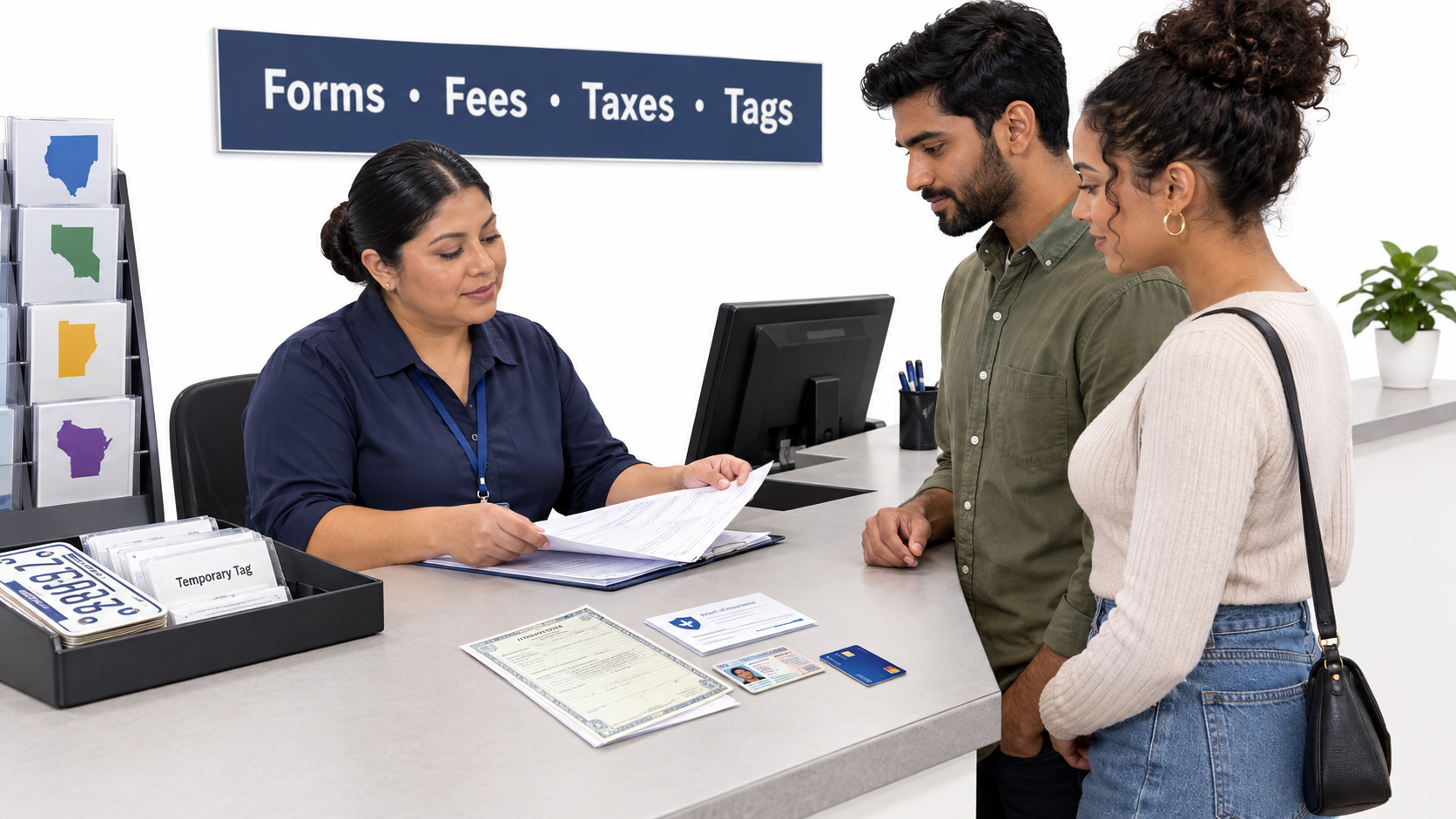
Couple completing title-transfer forms, fees, taxes, and temporary tag paperwork at a registration counter after checking out the door price car requirements.

The seller should provide a properly assigned certificate of title. The vehicle identification number on the title must match the number on the vehicle. Review the seller's name, the sale date, the sale price where required, mileage information, signatures, and every reassignment field. Do not accept a title with blank buyer fields, altered information, unexplained corrections, or a seller who says the remaining paperwork can be completed later.

Ask for a bill of sale when your state requires one or when it will help document the transaction. It should identify the buyer, seller, vehicle, sale date, purchase price, and signatures. Keep copies of the signed title, bill of sale, payment record, and delivery confirmation. These records can help show what was agreed if a registration, tax, or ownership question arises.

"A seller's statement that the loan has been paid is not the same as documentation from the lienholder."

If a lender is listed on the title, obtain an official lien release before completing the purchase unless the transaction is being handled through a process that clearly pays and releases the lien. A seller's statement that the loan has been paid is not the same as documentation from the lienholder. Ask who will send the lien information or release to the motor-vehicle agency and how you will confirm that the record was updated.

Review the odometer disclosure when it is required under federal or state rules. Compare the mileage on the title with the dashboard, inspection records, service records, and vehicle-history report. An unexplained difference needs an answer before you buy. Also request current registration and inspection documents where relevant, service and repair records, and any warranty or as-is disclosure.

Watch for title and paperwork problems

An open title is one in which the seller signs the document but does not identify the buyer. That arrangement can create ownership and tax problems and may prevent the state from processing the transfer. Title washing occurs when a vehicle with a brand such as flood or salvage moves through jurisdictions in a way that conceals important history. A branded title is not automatically proof that a vehicle is unsafe, but an unexplained or missing brand deserves careful verification.

Red Flags on Paper

Other warning signs include an unreleased lien, inconsistent mileage, a missing registration document, and even a single mismatched character in the vehicle identification number. Optional dealer products should be identified as optional. If a dealer allows you to take the vehicle and later asks you to accept different financing terms, stop and review the contract and financing status before agreeing to anything else.

For a dealer purchase, ask for copies of every signed document and the expected title-processing deadline. Dealers commonly handle title and registration paperwork, but you remain responsible for understanding what was promised and checking that the process is moving forward. For a private-party sale, you generally carry more of the burden for checking ownership, liens, title brands, mileage, taxes, and registration requirements.

The broad process is similar across the USA, but deadlines, fees, forms, inspections, taxes, and temporary-tag rules vary by state. Do not rely on a nationwide deadline such as 30 days unless the motor-vehicle agency for your registration state confirms it. Use the following sequence as a working checklist.

  1. Have the seller complete the assignment. The seller should enter the required sale information, including the date, price, mileage, buyer details, and signatures. Both parties should review the document before the vehicle and payment change hands.

  2. Complete the bill of sale. Use the state form if one is required. Otherwise, create a complete record that identifies the parties, vehicle, sale terms, date, and signatures.

  3. Resolve any lien. Confirm that the lender has been paid or that the transaction includes a documented process for payment and release. Ask how the state will receive the lien release and how you can verify it.

  4. Activate insurance. Arrange coverage that begins when you take ownership or when your insurer and state rules require it. Keep proof available for registration and delivery.

  5. Gather the application packet. This may include the assigned title, title application, identification, odometer disclosure, bill of sale, lien documentation, proof of insurance, tax payment, and fees. The exact list depends on the state and transaction type.

  6. Complete inspections or emissions requirements. Some jurisdictions require an inspection or emissions step before registration. Confirm whether the requirement depends on the vehicle, county, transaction, or model year.

  7. Submit the documents and register the vehicle. Use the state agency's instructions for an office visit, county tax office, online submission, or mailed packet. Obtain plates or a temporary permit through an authorized process.

  8. Keep proof of submission. Save receipts, copies, tracking information, temporary permits, and delivery confirmations until the title and registration process is complete.

Financing adds another layer. The lender generally becomes a secured lienholder, and you may not receive a paper title while the loan remains open. Ask whether the state maintains an electronic title, who reports the lien, what happens after payoff, and whether the lender or you must request the lien release. Put the answers in your records.

State procedures may also differ for gifts, inherited vehicles, out-of-state transfers, private sales, and dealer sales. California buyers may need to coordinate smog certification and transaction fees. Texas buyers may complete many title and registration transactions through county tax offices. New York buyers need to coordinate insurance, title, registration, and inspection steps. Florida buyers should pay close attention to flood and hurricane damage indicators. Arizona and Nevada buyers should verify county-specific emissions and out-of-state rules. These examples are reminders to check the current instructions for the exact registration location. California buyers can compare Used cars in CA while confirming smog certification and transaction-fee requirements.

Finish the purchase with a final verification

Before handing over the final payment, compare the vehicle and documents one more time. Check the VIN, mileage, title brand, seller identity, lien status, agreed price, included equipment, and delivery condition. If a dealer or acquisition service is handling the transaction, ask who is responsible for each document and when you will receive copies.

A buyer-side wholesale acquisition service such as VirtualCarHub.com may source used cars, trucks, and SUVs through dealer-only auction channels, arrange inspections, and coordinate financing, paperwork, and delivery. When evaluating any service, ask for the complete price, the inspection scope, the title-processing responsibility, the expected timeline, and the terms for any warranty or repair coverage. Terms vary, so confirm them in writing. Buyers seeking an SUV can review Used SUVs alongside the service's inspection and title-processing terms.

The same questions apply whether the vehicle comes from a private seller, dealership, auction-based service, or another source. You should know whether the vehicle is being sold with an as-is disclosure, which optional products are included, whether a lender is involved, and what happens if the title agency rejects a document. A clear answer is part of a complete transaction record.

"The title is a central ownership document, not a formality."

If the title transfer stalls

Contact the seller or dealer promptly if the title or registration does not arrive within the deadline or timeline you were given. Ask for the submission date, agency receipt, missing-document notice, lien-release status, and a specific next step. Keep the conversation in writing. If taxes, fees, or prior registration problems were not resolved, request an itemized explanation and copies of the relevant records.

Never Alter a Title Yourself

If a document is rejected, ask the motor-vehicle agency what correction is required before resubmitting anything. Do not alter a title yourself unless the agency expressly directs you to do so. A mismatched VIN, missing signature, blank reassignment field, or unrecognized lien may require the seller, lender, or issuing agency to correct the record.

When a dealer misses its title deadline, gives conflicting financing information, or presents optional products as mandatory, review the signed contract and seek help from the relevant state motor-vehicle agency or consumer-protection office. Federal and state rules address used-car disclosures, odometer information, financing, and consumer protection, but the correct remedy depends on the facts and jurisdiction.

Before you drive away, make sure the ownership trail is complete: verified title, matching VIN, resolved lien, accurate mileage disclosure, signed sale documents, insurance, taxes and fees, registration instructions, and a record of every promise. The title is a central ownership document, not a formality. Confirm the exact requirements with the state agency where the vehicle will be registered, then keep your copies until the process is finished.

Browse current inventory

Frequently asked questions

What should I check before paying for a used car?

Compare the vehicle identification number with the title and other records. Review the title, lien information, mileage, seller identity, agreed price, and delivery condition before making the final payment.

What documents should the seller provide?

The seller should provide a properly assigned certificate of title. Depending on state requirements, you may also need a bill of sale, current registration and inspection documents, lien release, odometer disclosure, and signed transaction records.

Can I buy a car with an open title?

An open title does not identify the buyer and can create ownership and tax problems. It may also prevent the state from processing the transfer.

Do title-transfer deadlines and fees vary by state?

Yes. Deadlines, fees, forms, inspections, taxes, and temporary-tag rules vary by state. Confirm the requirements with the motor-vehicle agency for the state where you will register the vehicle.

Related Articles