Hybrid vs. Electric vs. Gas

How American Buyers Should Choose the Right Powertrain

JULY 2026 EDITION

The New Buyer Equation

The American car buyer is no longer choosing between old technology and new technology. That framing is too neat, and frankly, it misses the messy reality of driveways, utility bills, winter mornings, apartment leases, dealer add-ons, family road trips, and the stubborn fact that a vehicle has to work on Tuesday at 7:15 a.m., not just in a spreadsheet.

Today, the real decision in the hybrid vs. electric vs. gas debate is about convenience, cost, and confidence. A gas vehicle may still be the smartest buy for a rural contractor in Wyoming. A hybrid could be the sweet spot for a family in suburban Ohio. A battery-electric vehicle might be a financial slam dunk for a California commuter with solar panels and a Level 2 charger in the garage. Same country. Three very different ownership realities.

That is why hybrids have become the serious middle-ground candidate in the USA market. They deliver much of the fuel-saving benefit shoppers want, without demanding a new relationship with charging infrastructure. EVs remain compelling, particularly for predictable daily driving and cheap home charging. Gas vehicles, though, have not disappeared into yesterday. They still win on purchase price, refueling speed, towing familiarity, and sheer geographic practicality. Shoppers comparing practical fuel-saving options can browse Used Toyota Prius alongside other hybrid choices.

"Forget the dinner-party argument about which powertrain is the future. The better question is more personal."

So forget the dinner-party argument about which powertrain is the future. The better question is: which one will cost you less, inconvenience you least, and fit how you actually drive? If you want the short version, this guide to choosing the right powertrain for your life distills the same thinking into a simple matching exercise.

Cost, Convenience, and Confidence

Start with the basics. A conventional gas vehicle uses an internal combustion engine and refuels at one of roughly 145,000 retail fuel stations across the USA, depending on how stations are counted. A hybrid pairs a gasoline engine with electric assistance and regenerative braking, usually without any need to plug in. A plug-in hybrid, or PHEV, adds a larger battery and can travel a limited distance on electricity alone before operating like a hybrid. A battery-electric vehicle, or EV, skips gasoline entirely and depends on charging.

Simple definitions. Complicated consequences.

The upfront price still shapes most decisions. According to Kelley Blue Book and Cox Automotive market reporting from recent model years, average EV transaction prices have fallen from their pandemic-era peaks and narrowed the gap with the broader market, yet many electric models still carry a higher sticker than comparable gas vehicles. Hybrids vary more. Some, like compact hybrid sedans and crossovers, may add only a modest premium. Others, especially larger SUVs and trucks with high-output hybrid systems, can be priced like luxury equipment packages.

Fuel cost is where the math starts to move. The U.S. Energy Information Administration has tracked gasoline swinging by more than a dollar per gallon within relatively short cycles in recent years, while residential electricity rates vary sharply by region. A driver in Washington state, where hydropower keeps electricity comparatively inexpensive, faces a different EV equation than a driver in parts of New England or California, where residential rates can be much higher. Gasoline is volatile. Electricity is regional. That matters.

Then there is depreciation, the great spoiler in every cost-of-ownership debate. Some EVs have suffered steep resale declines as price cuts, tax-credit changes, rental-fleet selloffs, and battery-health uncertainty collided. Certain hybrids, by contrast, have held value remarkably well because shoppers trust the technology and fuel economy remains attractive on the used market. Gas vehicles can be predictable, but their residual values depend heavily on segment. Full-size trucks? Still strong. Small sedans? Less so.

Verify Before You Budget

Under current rules, qualifying new EVs may be eligible for up to $7,500, but final eligibility depends on battery sourcing, assembly location, buyer income, MSRP caps, and model-year specifics. Used EVs may qualify for a smaller credit if they meet price and buyer requirements. Do not assume—verify the vehicle identification number before you build your budget around an incentive.

And yes, dealer fees can distort comparisons. Documentation fees, nitrogen tires, paint protection, VIN etching, reconditioning charges, market adjustments, and mandatory accessory packages can turn an attractive advertised price into a sour contract. This is one reason more buyers are asking how to avoid dealer fees when buying a car, or even asking, is there a way to buy a car without a dealership. There is, in some cases: direct-to-consumer brands, private-party transactions, fleet remarketing channels, and digital wholesale-style buying services can reduce friction. But each route carries its own paperwork, inspection, warranty, title, financing, and state-tax obligations.

The powertrain decision is inseparable from the buying channel. A hybrid bought at an inflated dealership price may lose its advantage. A used EV purchased at wholesale value with a verified battery report can be a bargain. A gas SUV with transparent pricing and car delivery to home may beat a supposedly cheaper alternative after fees and logistics are counted.
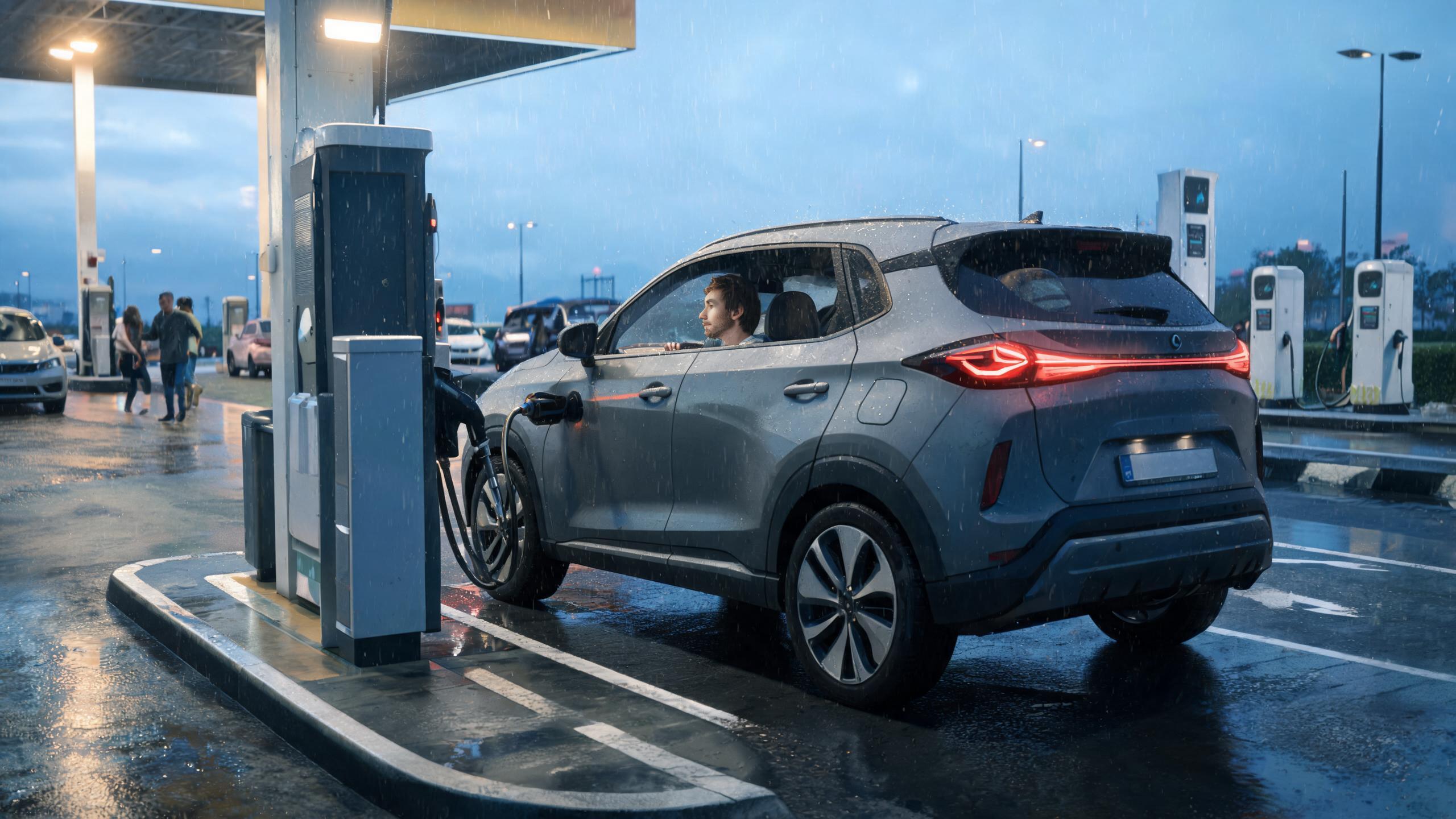
Hybrid driver refuels during rainy travel, showing a practical alternative for buyers comparing Carvana vs wholesale buying.

Hybrid: The New Default Bridge

Hybrids have quietly become the pragmatic answer for millions of buyers who want lower fuel bills but do not want a charging plan. No garage electrician. No route planning app. No waiting behind a broken fast charger in the rain off Interstate 95. You drive, brake, refuel, repeat.

"That ordinary simplicity is the point."

A well-executed hybrid shines in stop-and-go commuting because regenerative braking recaptures energy that a gas vehicle wastes as heat. In city driving, compact hybrids can achieve EPA ratings above 50 mpg. Hybrid SUVs often improve combined fuel economy by 25% to 50% compared with equivalent gas-only models, though the exact spread depends on vehicle size, drivetrain, tires, and whether all-wheel drive is fitted. For a household driving 12,000 to 15,000 miles a year, the savings can be tangible without changing habits. Used Used SUVs can provide a practical starting point for comparing hybrid efficiency across body types.

Toyota understood this earlier than most. The Prius made hybrids culturally recognizable, but the bigger move was putting hybrid systems into mainstream crossovers, minivans, and even trucks. Ford did something similar with the Maverick Hybrid, a small pickup that turned fuel economy into a workaday virtue rather than an eco-branding exercise. Honda, Hyundai, Kia, Lexus, and others have followed the same practical logic: put hybrid technology where American families already shop. The Used Ford Maverick illustrates how hybrid technology can serve everyday pickup buyers.

Hybrids also dodge several pain points that slow EV adoption. Cold weather affects them, but not as dramatically as it can affect EV range. Apartment dwellers do not need permission from a landlord to install a charger. Long-distance trips do not require charging stops. Rural buyers do not have to gamble on sparse public infrastructure. And for resale, buyers generally understand a hybrid battery better than they did 15 years ago. The fear has softened.

There are caveats. Hybrid systems add mechanical complexity. Repairs can be expensive if the high-voltage battery, inverter, or specialized cooling components fail outside warranty. Towing capacity may not equal that of traditional gas or diesel counterparts. And highway-heavy drivers may see a smaller fuel-economy benefit than urban commuters, because hybrids earn many of their gains from braking and low-speed electric assistance.

Still, for many mainstream buyers, the hybrid case is brutally practical. It costs less to fuel, rarely asks for behavioral change, and works across nearly every region of the USA. That is why automakers that once spoke as if the market would leap straight from gasoline to battery power have been recalibrating product plans. Buyers voted with purchase orders.

Car auction access for buyers in USA markets also reveals the hybrid premium in real time. Late-model hybrid crossovers with clean titles, strong service histories, and desirable trims often attract aggressive bidding from independent retailers and export buyers. Wholesale lanes can be brutally honest. When dealers fight over something, it is usually because retail customers already want it.

When Electric Wins

An EV can be the cheapest, smoothest, most satisfying vehicle in the household. Or it can become an expensive inconvenience with a beautiful screen. The difference usually comes down to charging.

If you can charge at home, especially overnight on a lower utility rate, the ownership equation changes dramatically. A Level 2 charger can add enough range while you sleep to cover ordinary commuting, errands, school runs, and weekend plans. No gas station. No oil changes. Fewer moving parts. Instant torque. Quiet cabins. For a driver doing 40 miles a day, the car effectively resets itself every morning. Home-charging shoppers can compare the Used Tesla Model Y with other EVs suited to predictable daily driving.

"A 20-minute charging stop is tolerable. A charger that will not initiate after three attempts is not a lifestyle upgrade."

Public charging is the weaker link. Networks have improved, and Tesla Supercharger access has set a high reliability benchmark, but the broader fast-charging experience remains uneven. J.D. Power surveys have repeatedly highlighted charger availability, payment issues, broken equipment, and wait times as consumer frustrations.

Regional differences are enormous. California, the Pacific Northwest, Colorado, and parts of the Northeast support EV ownership with stronger charging density, incentives, higher gasoline prices, and a larger base of experienced EV drivers. Texas and Florida present a more mixed picture: huge vehicle markets, expanding EV demand, long highway distances, heat-management concerns, and metropolitan charging clusters separated by big open spaces. The rural Midwest and Mountain West remain tougher territory for EV-only households, particularly for drivers who tow, travel unpredictably, or park outdoors in subzero conditions.

Winter deserves plain language. EVs lose range in cold weather because batteries are less efficient, cabin heat consumes energy, and rolling resistance can rise with winter tires and slush. Losses vary, but many owners see real-world winter reductions of 15% to 35%, sometimes more in severe conditions with highway speeds. Preconditioning while plugged in helps. Heat pumps help. Buying enough range helps most of all.

Towing is another stress test. Electric trucks can tow impressively, but range can fall sharply when pulling a trailer, especially at highway speeds. For a contractor towing daily within a known radius, an EV truck may work. For a family pulling a camper across Nebraska or Montana, the planning burden remains serious. Gas and hybrid trucks still have an advantage here, not because electric motors lack power, but because energy replenishment is faster and more widely available with liquid fuel.

Insurance and repair costs deserve attention too. EVs can cost more to insure in some segments because of battery pack replacement concerns, specialized repair procedures, aluminum structures, sensor-rich bumpers, and calibration requirements for advanced driver-assistance systems. A minor collision is no longer just a bumper cover and paint. It may involve radar brackets, cameras, cooling loops, and high-voltage safety protocols.

Yet EVs are not a niche curiosity anymore. For the right household, they are superb. A two-car family may keep a gas or hybrid SUV for long trips and use an EV for 90% of local driving. Fleet operators with predictable routes, such as municipal departments, airport shuttles, and last-mile delivery services, can model charging and maintenance with far more precision than retail buyers. That is where EV economics often look strongest first.

Digital buying platforms add another wrinkle. VirtualCarHub, for example, sits in a market where shoppers increasingly compare retail listings, wholesale-style pricing, transport costs, and home delivery before deciding whether a used EV, hybrid, or gas vehicle truly pencils out. The smart buyer is not just comparing powertrains. They are comparing acquisition channels.

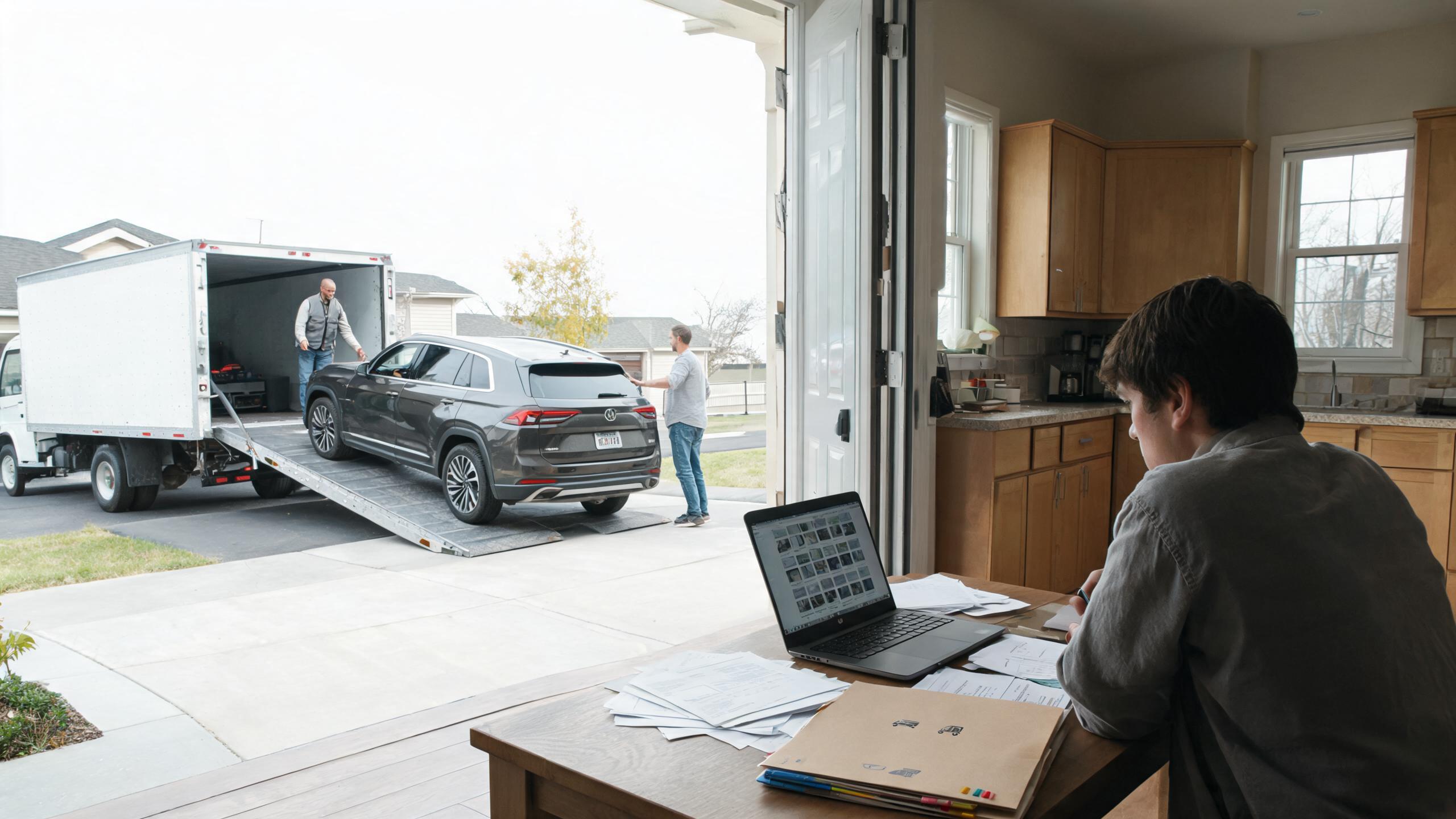
Used car delivered to a buyer’s home during an online purchase, illustrating car delivery to home and Carvana vs wholesale buying.

How You Buy Matters

The powertrain debate often ignores a less glamorous truth: how you buy the vehicle can save or waste as much money as the powertrain itself.

Retail platforms such as Carvana made online buying feel normal by combining searchable inventory, financing, trade-in tools, and car delivery to home. For many shoppers, that convenience is worth paying for. The vehicle arrives in the driveway. The paperwork is mostly digital. The old Saturday-at-the-store ritual disappears. No fluorescent showroom. No finance-office ambush. Bliss, at least when the title work and vehicle condition match expectations.

But Carvana vs wholesale buying is not a trivial comparison. Wholesale buying, auction access, and dealer-only lanes can expose buyers to lower acquisition prices, especially on off-lease vehicles, fleet returns, repossessions, and trade-ins that have not yet been reconditioned for retail. The discount is real when the buyer understands condition reports, arbitration rules, transport costs, title branding, and post-sale inspection windows. The risk is real too.

Inspection Standards by Powertrain

A used EV should have a battery-health report where possible, charging verification, software status review, tire inspection, and recall confirmation. A hybrid should be scanned for high-voltage battery codes, inverter issues, cooling-system problems, and abnormal fuel-economy complaints. Gas vehicles still need the old-fashioned checks: compression where warranted, oil leaks, transmission behavior, maintenance records, and underbody corrosion, especially in salt-belt states.

This is why car auction access for buyers has become a growing point of interest. Traditionally, many auctions were limited to licensed dealers. Some public auctions exist, and some platforms or intermediaries help consumers participate in auction-style purchasing. The appeal is obvious: bypass retail markup and shop closer to the source. The problem is equally obvious: a bad auction purchase can erase any savings with one battery fault, transmission issue, title delay, or undisclosed structural repair.

Home delivery changes the geography of shopping. A buyer in Georgia can purchase a hybrid from Ohio. A California shopper can find a gas-free commuter from Arizona. A Florida retiree can compare a locally listed compact SUV against a lower-mileage unit several states away. Shipping typically ranges from several hundred dollars to well above $1,500 depending on distance, vehicle size, open versus enclosed carrier, and seasonal transport demand. That number belongs in the deal math from the beginning, not as a late surprise.

Dealer fees need the same discipline. Ask for an out-the-door price before discussing monthly payment. Separate taxes and registration from dealer-imposed charges. Challenge add-ons that were not requested. Compare documentation fees by state; some states cap them, others allow wide variation. In Florida, dealer fees can be notoriously high. In California, documentation fees are capped at a relatively low level. In Illinois, caps and rules differ again. Local regulation matters.

"The answer is not always to avoid dealers entirely. It is to force transparency."

For shoppers asking how to avoid dealer fees when buying a car, the answer is not always to avoid dealers entirely. It is to force transparency. Get the buyer order. Read every line. Be willing to walk. Consider private-party, direct-sale, auction-assisted, or fixed-price digital options when the economics are cleaner. VirtualCarHub and similar marketplaces are responding to exactly this buyer frustration: people want inventory access and logistical help without feeling trapped in a fee maze.

A Practical Framework

Choosing the right powertrain should not start with ideology. Start with your calendar, your parking spot, your climate, and your bank account. Less glamorous. Much more useful.

Choose gas if your driving is irregular, rural, or towing-heavy

A gas vehicle remains sensible if you routinely drive long distances without predictable stops, live where public charging is thin, rent or street-park without reliable charging, tow heavy loads, or need the lowest acquisition price. Full-size pickups, body-on-frame SUVs, older minivans, and budget compact cars still deliver value in the right use case. Fuel economy may not impress anyone, but utility counts. Buyers who tow or need utility can compare available Used Trucks for this use case.

Choose hybrid if you want lower fuel bills without changing your routine

For commuters, suburban families, rideshare drivers, and city-heavy users, hybrids may be the most broadly rational option on the market. They are especially persuasive when gasoline prices rise, but unlike EVs, they do not require home charging to make sense. If you drive 15,000 miles a year and spend plenty of time in traffic, a hybrid crossover or sedan can quietly save money month after month.

Choose electric if you can charge at home and your mileage is predictable

EVs excel for homeowners with Level 2 charging, commuters with consistent daily range needs, buyers eligible for meaningful incentives, and households that can keep another vehicle for road trips or towing. They also work well for fleet routes, urban delivery, and high-mileage local driving where fuel and maintenance savings compound quickly. The key phrase is can charge reliably. Without that, the ownership experience can sour.

Consider a plug-in hybrid if your life is split between short commutes and long trips

PHEVs can be brilliant or disappointing, depending on behavior. If you plug in daily and drive within the electric range most weekdays, fuel use can plummet. If you never plug in, you are hauling around extra battery weight and complexity for little benefit. The buyer matters as much as the machine.

Before signing anything, run a three-year cost comparison. Include purchase price, taxes, fees, financing rate, insurance, fuel or electricity, expected maintenance, charging equipment, state incentives, resale assumptions, and delivery costs. Use EPA fuel economy numbers as a baseline, then adjust for your driving. Highway commuters should be skeptical of city-heavy estimates. Cold-climate EV shoppers should build in a winter buffer. Towing households should be brutally honest.

Also look beyond the model-year hype. The best deal may not be the newest vehicle. A two-year-old hybrid with warranty remaining can be better than a brand-new gas model with heavy dealer add-ons. A used EV that qualifies for a tax credit can undercut both if the battery is healthy and charging fits your life. A gas vehicle bought cleanly at a fair price can still be the least risky financial move.

The smartest answer, then, is not universal. EVs are the future in many segments, especially as battery costs fall and charging improves. Gas will remain relevant longer than some forecasts admit, particularly in rural and work-focused use cases. Hybrids? They are the present-tense compromise, the bridge technology that no longer feels like a compromise.

"Buy the powertrain that fits your real life. Not your neighbor's driveway. Yours."
  • If you have dependable home charging and drive predictable daily miles, put EVs at the top of the list.
  • If you want efficiency without infrastructure homework, shop hybrids first.
  • If you tow, travel unpredictably, or need the lowest purchase price, gas still deserves a serious look.
  • If you are comparing online retail, auction access, or dealership offers, calculate the full out-the-door cost before falling in love with the monthly payment.

That is the grown-up version of the hybrid vs. electric vs. gas debate. Not a winner-take-all contest. A matching exercise. And when you get the match right, the vehicle feels less like a bet on technology and more like what it should have been all along: a tool that fits.

Browse current inventory

Frequently asked questions

Which powertrain is best for buyers without reliable home charging?

A gas vehicle or hybrid may make more sense because they do not depend on home charging. Hybrids provide fuel savings without requiring a charging plan, while gas vehicles offer broad refueling access.

When is an electric vehicle a good fit?

EVs work well for households with reliable Level 2 home charging, predictable daily driving, and access to suitable charging infrastructure. They can also be effective for local fleet routes and urban delivery.

Are hybrids practical for long-distance driving and towing?

Hybrids work across nearly every region and do not require charging stops, but their towing capacity may be lower than comparable gas or diesel vehicles. Gas and hybrid trucks have an advantage when energy replenishment needs to be fast and widely available.

What should buyers include when comparing ownership costs?

Compare purchase price, taxes, fees, financing, insurance, fuel or electricity, maintenance, charging equipment, incentives, resale assumptions, and delivery costs. Adjust EPA fuel-economy estimates for your driving conditions, climate, and towing needs.

Related Articles