The Battery Is the Story

How to Check a Used EV's Battery Health Before Buying, and What Range Loss Is Normal

USED EV BUYER'S GUIDE · SEPTEMBER 2026

The Most Expensive Part You Can't See

Why the Odometer Isn't Enough

The most expensive part of a used electric vehicle isn't the touchscreen, the glass roof, the self-driving promise, or the badge on the hood. It's the battery pack. And in the used-car market, that pack can be both the greatest bargain and the least understood risk you'll ever take on four wheels.

Across the USA, used EV listings now sit beside gasoline SUVs, half-ton pickups, and compact crossovers on the same search pages, often with tempting monthly payments and cheerful claims about range. Here's the catch: a used EV doesn't reveal itself through mileage alone. A three-year-old electric crossover with 42,000 miles might be a healthier buy than a two-year-old sedan with 18,000 miles, if the first car lived on Level 2 charging in Oregon while the second spent its life fast-charging in Phoenix heat as a rideshare vehicle. The odometer is useful. It just isn't the whole story. Compare battery health across Used SUVs and other used EV body styles before relying on mileage alone.

That's the awkward truth behind today's used-EV shopping experience. Buyers are being asked to judge a high-voltage drivetrain inside a retail system built around oil changes, accident reports, and tire tread. There's no single mandatory battery-health label for used EVs in the USA. No universal state-of-health disclosure. No simple Monroney-style sticker telling a second owner how much usable capacity remains. So you have to know what to ask, which numbers matter, and which reassuring answers are basically vapor.

"The battery is the engine, fuel tank, and resale value all in one. Treat it that way."

For buyers who understand the process, a used EV can be a sharp financial move. Depreciation has already done its damage, federal and state incentives may help certain buyers, and operating costs can run dramatically lower than gasoline ownership depending on your local electricity rates. But the deal has to begin with battery evidence, not sales patter. Whether you're buying from a franchise dealer, an online retailer, a private seller, or a buyer-side wholesale acquisition service such as VirtualCarHub.com, the rule holds: verify the pack before you fall in love with the price.

What Battery Health Actually Means

State of Health, in Garage Language

Battery health usually gets discussed through a figure called State of Health, abbreviated SOH. In plain terms, SOH estimates how much usable capacity a pack still has compared with when it was new. Say a car originally shipped with 75 kilowatt-hours of usable capacity and now has roughly 68 available. That might show an SOH somewhere around 90% to 91%, depending on the diagnostic method and the manufacturer's buffer. Use listings for Used cars under $50k as a starting point, then verify each vehicle's usable capacity and SOH.

Don't confuse that with the range number glowing on the dashboard. Displayed range is a forecast, not a lab result. It shifts with driving history, outside temperature, tire pressure, wheel size, elevation, HVAC use, software logic, and whether the last driver treated the accelerator like an arcade button. In January in Minnesota, the same EV can show far less estimated range than it did in September in coastal California, even if the battery hasn't meaningfully degraded. Cold weather slows battery chemistry and cabin heat eats energy. Physics isn't impressed by marketing copy.

SOH is the more durable measure. It's not perfect, and automakers calculate it differently, but it gives you firmer footing than a seller shrugging, "It still gets about 250 miles." About? In what weather? At what speed? On which tires? Was the battery preconditioned? Range is a moving target. Capacity is harder to spin.

Read the Booklet, Not the Summary

Many mainstream EV batteries carry warranties around eight years or 100,000 miles, though terms vary by brand, model, model year, and state emissions rules. Some manufacturers cover the pack if capacity drops below a defined threshold, commonly around 70%, during the warranty window. Others frame coverage around defects rather than ordinary wear. Read the actual warranty booklet. Not the dealer's summary. Not a forum post. The booklet.

Normal degradation is gradual. A modest loss over the first few years is expected, then the curve tends to flatten. Broadly, you shouldn't panic over single-digit capacity loss on a well-maintained three- or four-year-old car. A vehicle showing 88% to 94% SOH may still be perfectly sensible, depending on price, warranty, use case, climate, and original range. A car near or below 80% deserves deeper scrutiny. Once you drop below warranty thresholds, it becomes a negotiation, a repair question, or a hard pass.

EPA Range vs. Real-World Range

The EPA-rated range is a standardized estimate for a new vehicle under test conditions. Handy for comparing models when new. It's not a promise to future owners. A 2021 EV rated at 300 miles when new may reasonably deliver 250 to 270 on a mild day after several years, especially at highway speed. Bolt on winter tires, drive 75 into a headwind, run cabin heat in Chicago, and the number turns ugly fast. That isn't always battery failure. Sometimes it's just America being America: big distances, fast roads, brutal seasons. A used sedan's EPA range is only a baseline, so compare real-world capacity and conditions before choosing Used Sedans.

So the better question isn't "Does it still match the window sticker?" It almost certainly won't, at least not consistently. Ask instead: does the usable range fit your actual weekly driving, with a reserve for weather, detours, aging, and charging availability?

  • Daily commute of 38 miles with home charging? A moderate SOH loss may be irrelevant.
  • Frequent 220-mile highway trips in the Mountain West? Battery health and charging speed matter a lot.
  • Apartment living with only public fast chargers nearby? Be picky. Very picky.
  • Cold-climate ownership in New England, Michigan, or the Upper Midwest? Build in a winter range penalty before you buy.
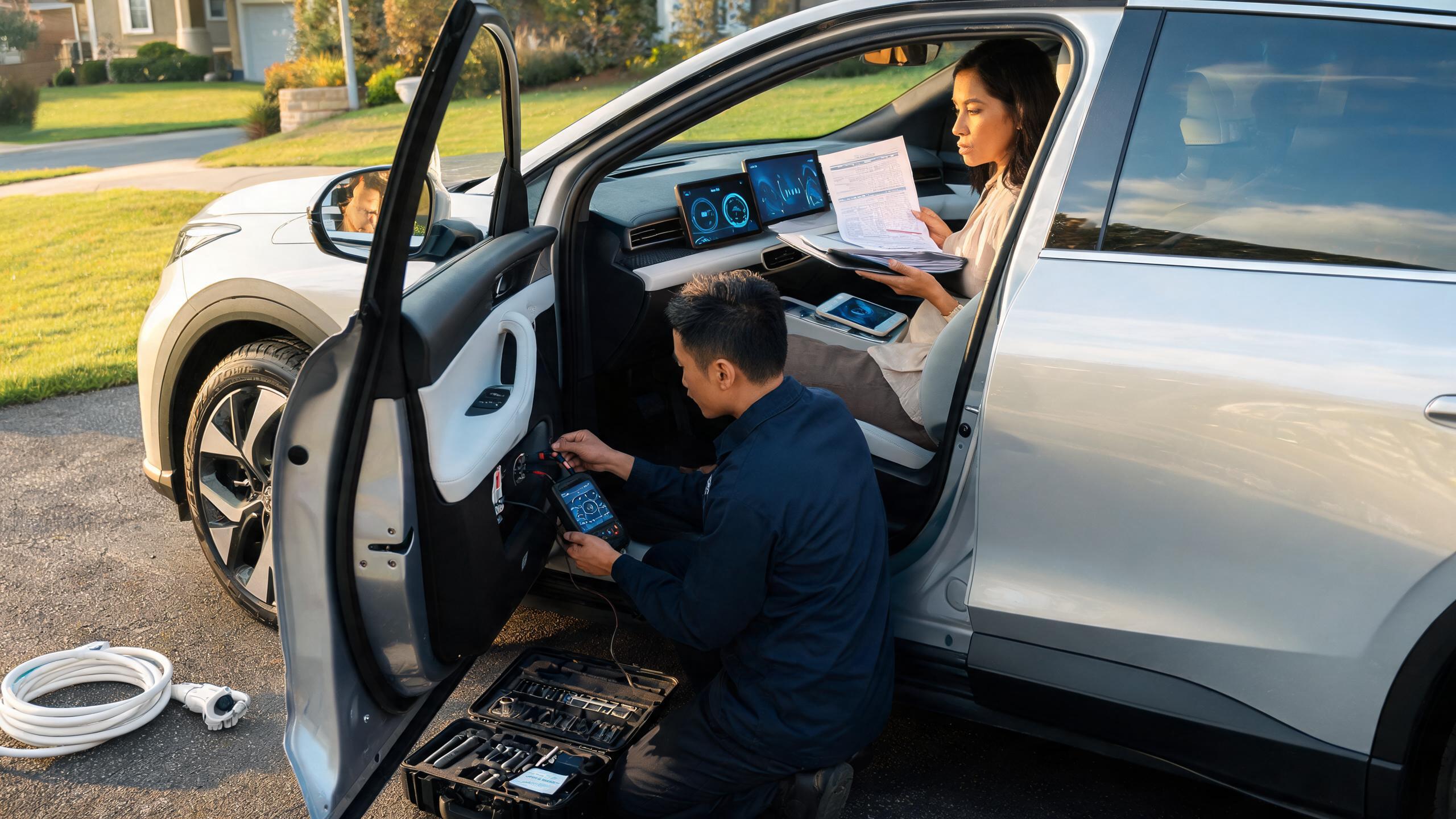
Mobile technician checking a used EV battery with diagnostics and service records before purchase, useful for shoppers comparing car delivery to home listings

How Dealers Buy, and Why Reports Go Missing

Inside the Wholesale Lanes

To understand why battery transparency is so uneven, look at how dealers actually buy cars. A large share of late-model used vehicles moves through dealer-only auctions, off-lease lanes, fleet remarketing pipelines, rental disposals, trade networks, and manufacturer closed sales. Cars can pass through inspection lanes fast. The condition report might list paintwork, tire depth, frame announcements, prior damage, and odometer status. Battery SOH? Often absent, incomplete, or buried behind brand-specific tools.

Traditional used-car appraisal grew up around internal-combustion vehicles. Listen for engine knock. Check the shift. Look for leaks. Scan for codes. Inspect underbody rust. EVs demand a different skill set entirely: high-voltage diagnostics, thermal management history, charging behavior, module imbalance, software update status, battery recall completion, DC fast-charging exposure. Some dealers are learning quickly. Others are winging it with the confidence of a man selling boats in the desert.

Why does this gap matter? Because the used-EV buyer isn't just shopping a car. You're shopping stored energy. Set two identical electric SUVs side by side, both with 35,000 miles, clean histories, similar cosmetics. The one with verified 94% SOH is materially different from the one at 83%. The market is starting to price that difference, but unevenly. In auction lanes and online listings, uncertainty tends to get passed downstream to consumers.

"Convenience has a price. So does uncertainty."

Online car dealer markup can make the opacity worse. A no-haggle retailer may fold acquisition cost, reconditioning, transport, financing economics, warranty products, and retail overhead into one tidy advertised price. It looks clean. Sometimes it genuinely is convenient. Yet you may still receive no meaningful battery certificate. That's part of why online used cars cost more in many cases, not because every retailer is gouging, but because the digital retail model bundles convenience, inventory risk, logistics, marketing spend, and margin into the transaction.

Look at CarMax pricing through this lens and it's fairly straightforward. Large retailers price vehicles using market data, velocity targets, reconditioning costs, brand reputation, warranty exposure, and local demand. Their numbers may be fair for some shoppers and high for others. The sharper question isn't whether the price is "good." It's whether the price reflects verified battery condition. A used EV with no SOH report isn't the same product as one with a credible diagnostic, and it shouldn't be priced as if it were.

Wholesale Access Changes the Conversation

Buyer-side wholesale acquisition flips the usual retail sequence. Instead of browsing cars already marked up on a lot or a national website, you define the target vehicle, budget, acceptable battery metrics, warranty needs, and delivery constraints before sourcing begins. VirtualCarHub.com, for instance, works from dealer-only auction channels, arranges inspection, and handles financing, paperwork, and delivery without a retail lot or a commissioned salesperson nudging you toward aged inventory. That structure doesn't magically make every EV perfect. It does create room for a more forensic purchase.

The best buyer-side process sets battery requirements before bidding. Minimum SOH. No unresolved high-voltage recalls. No flood history. No unexplained charging faults. No former rideshare use unless it's priced accordingly and inspected closely. For EVs, discipline beats enthusiasm. Every single time.

How to Check a Used EV Battery Before You Buy

Start with documentation, move to diagnostics, then validate with behavior. Sellers love to show clean interiors, big screens, and shiny paint. Fine. Look at all of it. Then ask for the battery report.

A credible EV battery review should include SOH or remaining usable capacity, diagnostic trouble codes, warranty status, recall completion, charging performance, and any manufacturer-specific battery flags. Depending on brand, a dealer can often generate a service printout from factory diagnostic software. Some independent EV specialists use third-party tools that estimate degradation through telematics, onboard data, or controlled charge testing. None of these methods is flawless. All of them beat guessing from the dashboard.

If the seller can't provide a battery report, ask why. A private seller may simply not know how to get one, and that's fixable. A dealer moving dozens of used EVs with no battery-health documentation is a different animal. Maybe they haven't built the process yet. Maybe they don't want the number in writing. Neither explanation does you any favors.

Confirm the warranty next. You want the in-service date, current mileage, title status, transfer rules, and the manufacturer's capacity-loss threshold. Salvage, branded, or flood titles can complicate or void coverage. Software recalls can affect battery behavior too, especially where automakers have changed charging limits, thermal controls, or usable capacity after field issues.

Then test the charging. A weak or troubled battery may show odd symptoms: abrupt range drops, sessions that stop unexpectedly, unusually slow DC fast charging under reasonable conditions, warning lights, or reduced-power "turtle mode." Be careful, though. Charging speed depends on charger output, battery temperature, state of charge, the charging curve, and station reliability. A cold pack plugged into a mediocre public charger may crawl even when the car is perfectly healthy. Context, again.

Buying by Delivery? Trust Nothing Blind

Car delivery to home is convenient, particularly if you live in a rural part of the USA where EV inventory stays thin. Delivery shouldn't mean blind trust. Insist on inspection windows, written return policies, diagnostic documents, and clear title and warranty confirmation before the transporter ever pulls up to your curb.

There's a human temptation to rationalize a cheap EV. "It's probably fine." Maybe. But probably fine is a poor standard for a battery pack that can cost five figures to replace outside warranty. Better to miss a deal than inherit someone else's expensive mystery.

What Range Loss Is Normal, and When to Walk Away

Normal range loss depends on chemistry, age, mileage, climate, charging pattern, and original battery design. A small decline from original EPA range is ordinary. A noticeable seasonal swing is ordinary. A dashboard estimate that shifts after a software update or a week of highway driving is ordinary. What's not ordinary: a dramatic, unexplained collapse in usable range, persistent charging faults, or an SOH number sitting far below comparable vehicles with no honest explanation baked into the price.

As a rough framework, a late-model used EV above 90% SOH is generally encouraging. Mid-to-high 80s can still work if the price is right, the warranty's active, and your driving needs stay modest. Low 80s call for caution. At or near 70%, you're in warranty-threshold territory for some brands, but don't assume the manufacturer will automatically swap the pack. They'll test it under their rules, with their equipment, against their capacity standard.

Climate distorts expectations. In hot-weather states like Arizona, Nevada, Texas, and inland California, prolonged heat stresses batteries, especially when cars sit at high states of charge. Modern thermal management helps. It doesn't repeal thermodynamics. Up in Minnesota, Wisconsin, Colorado's mountain towns, and Maine, winter range loss can look severe even in a healthy EV. That's operational range loss, not necessarily permanent degradation. Separate capacity from conditions.

Charging behavior deserves special attention. Occasional DC fast charging is no scandal; EVs are built for it. Constant fast charging, especially to high states of charge in hot weather, is harder on a pack. Long storage at 100% can accelerate wear in many lithium-ion chemistries too. A prior owner who charged nightly to 80% in a garage probably did the battery a favor. A rideshare driver who fast-charged twice a day and parked it full in summer heat likely did the opposite.

Fleet history gets tricky. Former rental EVs, corporate cars, and rideshare vehicles aren't automatically bad buys. Some are maintained well and priced honestly. But fleet-to-retail cars often rack up miles quickly, see many drivers, and lean heavily on public charging. That deserves a discount, a deeper inspection, or both. Clean cosmetics can hide a tired battery. The seats may look new while the pack has lived a hard life.

"The best used-EV deal is sometimes the one you don't buy."

Red Flags That Should Slow the Deal

  • The seller refuses or keeps delaying battery-health information.
  • The car throws unexplained high-voltage warnings, charging interruptions, or reduced-power messages.
  • Displayed range sits dramatically below similar cars in similar weather, with no diagnostic to explain it.
  • There's flood history, especially from hurricane-prone regions or coastal storm events.
  • Warranty status is unclear, expired, voided, or tangled in unresolved title issues.
  • The asking price matches healthier examples even though SOH is materially lower.

Flood exposure deserves its own hard line. High-voltage components and water intrusion make a miserable combination. After hurricanes along the Gulf Coast, Florida, the Carolinas, and other flood-prone regions, damaged vehicles migrate through auctions and surface far from where the storm hit. A clean-looking EV in Ohio or Colorado may have a past life in a flooded zip code. Title washing is less common than the fearmongers claim, but it happens often enough to justify vigilance.

The financial logic is simple: verified battery health supports resale value, and unverified condition subtracts from it. In a mature market this would be obvious in every listing. Today, you often have to force the conversation yourself.

The Smarter Way to Buy a Used EV

Buy a used EV more like a high-value drivetrain asset than a gadget with wheels. That shift changes everything. You stop asking only whether the monthly payment works. You ask what the battery is worth, how it was treated, what the warranty will actually cover, and how the car performs on your roads in your weather.

Market structure matters here. Retail lots and online platforms have their uses, but they usually present cars after the margin is already baked in. Buyer-side acquisition starts closer to the source. By targeting wholesale channels, screening condition before purchase, and cutting out commissioned sales pressure, services in this category can align the search around your risk tolerance rather than the seller's inventory problem. No model erases risk. A better process trims avoidable surprises.

Comparing traditional retail with wholesale acquisition shouldn't be an ideological fight. Make it evidentiary. Who can show battery SOH? Who documents warranty status? Who arranges an EV-literate inspection? Who explains why online used cars cost more when convenience and markup get bundled together? Who will walk away from a bad unit even when it looks profitable to sell? That last one is underrated. A cheap car with weak battery documentation, murky history, and optimistic range claims isn't a bargain. It's a deferred argument with physics, paperwork, and your bank account.

Before signing, set your own minimum standard. For a commuter EV, maybe you require 85% SOH or better, an active battery warranty, a clean title, no flood record, and verified Level 2 charging. For a road-trip EV, raise the bar: stronger SOH, proven DC fast-charging performance, adequate winter range, and a charging network that fits your routes. For a budget city car, you might accept more degradation if the price reflects it and your daily mileage runs low. Context, always. Shoppers considering Used cars under $40k should match the price with the required SOH, warranty, title, and charging standards.

Used EV buying in the USA is entering its grown-up phase. Prices beat the pandemic-era shortage days. Inventory is broader. Shoppers are savvier. Yet battery disclosure still trails the stakes of the purchase. Until the industry adopts standardized battery-health certification, you have to act as your own auditor. Ask for the report. Verify the warranty. Respect the climate. Price the degradation. And never let a glossy listing convince you that range loss is a minor footnote. In an electric vehicle, the battery is the story.

Browse current inventory

Frequently asked questions

What is SOH, and why does it matter?

State of Health, or SOH, estimates how much usable battery capacity remains compared with when the pack was new. It provides firmer footing than relying on the dashboard's changing range estimate.

What SOH is considered normal for a used EV?

A vehicle showing 88% to 94% SOH may still be sensible depending on price, warranty, use case, climate, and original range. A car near or below 80% deserves deeper scrutiny.

What should I request before buying a used EV?

Ask for a battery report covering SOH or remaining usable capacity, diagnostic trouble codes, warranty status, recall completion, charging performance, and manufacturer-specific battery flags.

How does cold weather affect an EV's range?

Cold weather slows battery chemistry and cabin heat uses energy, so the same EV can show much less estimated range in winter even when the battery has not meaningfully degraded.

How can I check whether a used EV has battery problems?

Review documentation, obtain diagnostics, and test charging behavior. Watch for abrupt range drops, unexpected charging stops, unusually slow DC fast charging, warning lights, or reduced-power turtle mode, while considering charger and battery conditions.